Why Your Interval Walking Pace Targets Need Resetting Each Season
Quick Answer: Interval walking is prescribed by effort, not by pace - the Japanese protocol specifies roughly 70 percent of peak capacity for the fast intervals and about 40 percent for the slow ones. But most people quietly convert that into a pace on their watch and then defend the number. When conditions change, the same pace is a different effort. Cooler air makes a given pace easier, so your July fast pace becomes a moderate effort in October; wind, hills, layers and darker surfaces all push the other way. Reset the target with a simple talk test every season change rather than carrying the number forward.
You have been hitting 3.8 mph on the fast intervals since June, and it either feels far too easy now or unaccountably hard depending on the day.
The protocol was never about the number.

What does the protocol actually specify?
Effort levels, not paces - and the distinction is the whole method.
The interval walking protocol that came out of Japanese research uses three minutes of fast walking alternating with three minutes of slow walking, repeated for around 30 minutes, most days of the week.
The fast intervals are prescribed at roughly 70 percent of individual peak aerobic capacity and the slow intervals at around 40 percent. In the original research, those percentages were established through testing.
Nothing in that is a pace. Two people at the same 70 percent effort will walk at very different speeds, and the same person at 70 percent walks at different speeds on different days and in different conditions.
The reason the method works is the contrast. The alternation between genuinely brisk and genuinely easy produces the training stimulus - a continuous moderate walk at the average of the two does considerably less. That contrast only exists if the fast intervals are actually at the intended effort.
Which is why a stale pace target degrades the whole session. If your fast pace has become a moderate effort, you are doing a continuous moderate walk with a slightly slower bit in the middle - which is a fundamentally different and less effective session.
The practical reframe: the pace is a readout, not a target. Watch it, log it, do not chase it.
Why does the same pace feel different in autumn?
Cooler air removes a cost you were paying, and several smaller factors push both ways.
Heat is the largest one. In warm conditions, a share of your cardiac output goes to skin blood flow for cooling, so heart rate at a given pace is higher and the effort is greater. Remove the heat and the same pace costs less - which means the pace that was 70 percent in July may be 60 percent in October.
Humidity compounded it. High dew point slows sweat evaporation and raises the cost further, and autumn typically brings a substantial drop.
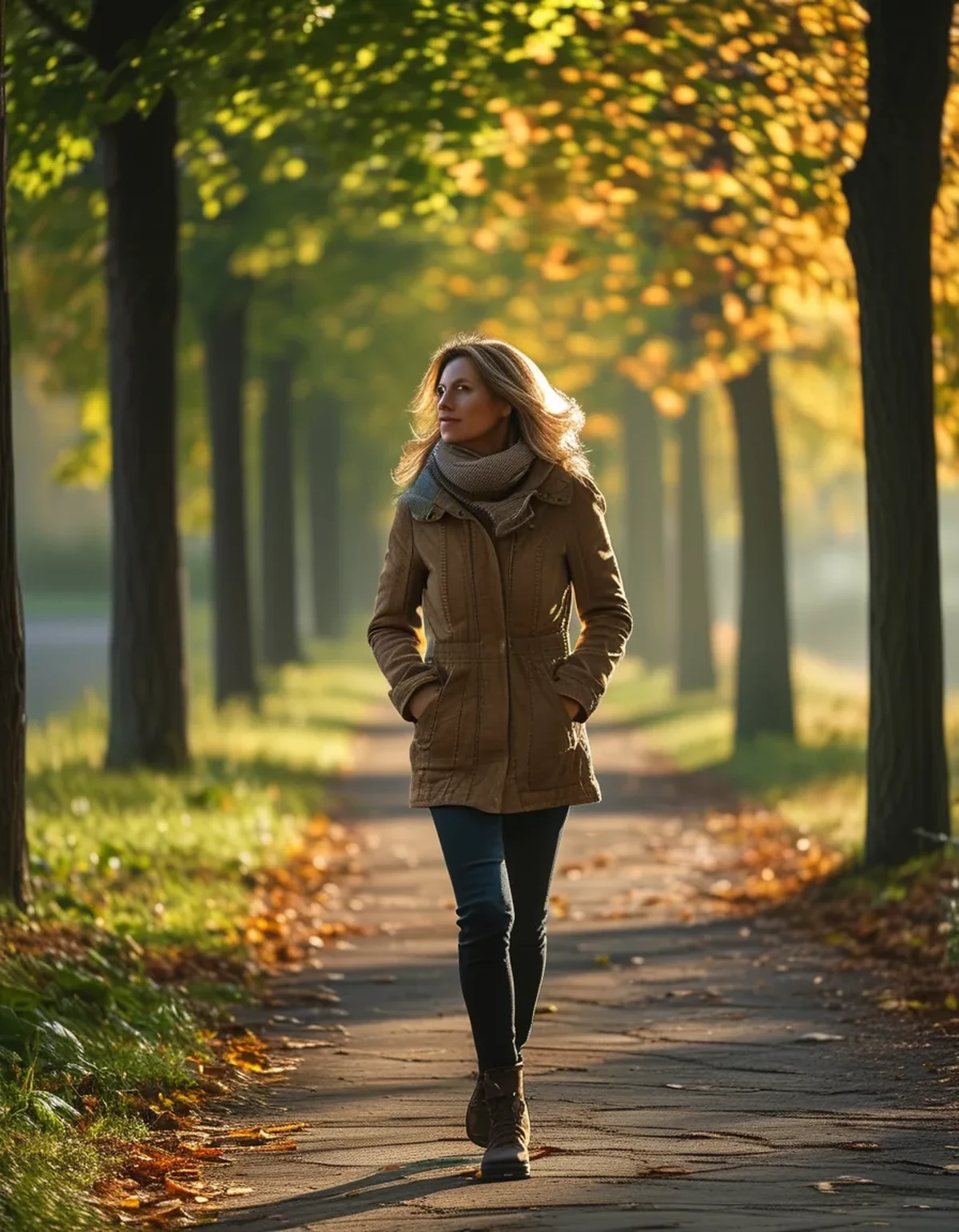
Pushing the other way: wind is a real load and autumn is windier in most regions. Walking into a headwind at the same pace is a meaningfully higher effort. Layers add weight and restrict movement slightly. Wet or leaf-covered surfaces reduce push-off efficiency. And darker conditions shorten stride - people unconsciously walk more cautiously when they can see less, which lowers pace at unchanged effort.
Terrain changes too, if your route conditions vary with the season.
The net effect is not predictable in advance, which is exactly why holding a fixed pace target is the wrong approach. On a still, cool, dry day your July pace is easy. On a windy, wet, dark evening the same number is unreachable and chasing it produces a session that is too hard.
Effort-based prescription self-corrects for all of it automatically. That is its entire advantage.
Myth vs Fact: Pace and Interval Walking
Myth: If your pace drops, your fitness has declined. Fact: Pace at a given effort is affected by wind, surface, temperature, footwear, layers, light and terrain. A slower pace on a windy October evening tells you about the wind. Compare paces only within similar conditions.
Myth: Faster is always better for the fast intervals. Fact: Above the target effort, the slow intervals stop being recoverable and the session degrades - you cannot complete the prescribed alternation if the fast portion is too hard. The protocol depends on being able to repeat it, and going too hard early is the most common execution error.
Myth: Heart rate is a better target than pace. Fact: Better, but not clean. Heart rate is affected by heat, hydration, caffeine, sleep and stress, and wrist sensors are less accurate on cool skin in autumn. It is a useful secondary check, not an authority.
Myth: The slow intervals are just rest. Fact: They are prescribed at around 40 percent, not zero. Stopping or strolling too slowly reduces the training effect and makes the session shorter in real terms. Slow means easy walking, not standing.
Myth: You should hit the same distance every session. Fact: Distance is an outcome, not a target. Fixing distance while conditions vary means the effort varies instead, which is exactly backwards. Fix the time and the effort; let the distance land where it lands.
How do you reset the target?
A talk test, once per season, taking one session.
The talk test is the most practical field measure of effort and it needs no equipment. During a fast interval at the correct intensity, you should be able to speak in short phrases but not hold a comfortable conversation - breathing is clearly elevated and speech is broken into chunks.
During a slow interval, full sentences should be comfortable.
If you can chat easily during the fast interval, it is too slow. If you cannot get more than a word or two out, it is too fast.
Do this once at each season change - roughly four times a year, or whenever your training environment changes substantially, including a move indoors to a treadmill.
Note the resulting pace and use it as your working reference for that season, then re-check when conditions shift again.
Rate of perceived exertion works too if you prefer a number. On a 1 to 10 scale, the fast intervals sit around 6 to 7 - noticeably working, sustainable for the three minutes, and clearly not maximal.
Treadmill targets need their own reset. Indoor walking in still air at the same pace is a higher effort than outdoors, and treadmill belts assist slightly. Never carry an outdoor pace target onto a treadmill or the reverse.
And log the conditions alongside the session. Temperature, wind, surface, light. Six weeks of that turns a confusing set of paces into a clear picture of what your actual fitness is doing underneath the weather.
FAQ: Seasonal Pace Questions, Answered
How often should I actually retest?
Four times a year at the season changes covers most people, plus any time your environment changes substantially - moving to a treadmill, changing routes, or a shift to training at a different time of day. It takes one session and it prevents a whole season of training at the wrong intensity.
Can I use heart rate zones instead of the talk test?
Yes, as a secondary check. The complication is that heart rate itself shifts across the season - the plasma volume you gained over a hot summer reverses within a couple of weeks of cooler training, which raises heart rate at a given effort temporarily. If you use heart rate, expect a couple of noisy weeks during the transition and lean on the talk test through it.
My pace dropped a lot when I started walking in the dark. Is that normal?
Yes, and it is largely unconscious. People shorten their stride and walk more cautiously with reduced visual information about the surface, particularly on paths with leaves or uneven pavement. The effort can be unchanged while the pace drops noticeably. Use effort as the target and let the pace be lower on dark routes - or use a brighter route if the pace matters to you.
Should I walk faster to compensate for wearing more layers?
No - the layers are part of the load, so the same effort at a slightly lower pace is the correct response. Chasing your summer pace while carrying more weight and restricted movement pushes the fast intervals above the target intensity, which compromises the slow intervals and the session as a whole.
TL;DR:
- The protocol prescribes effort - about 70 percent for fast intervals, 40 percent for slow - not a pace.
- The contrast between fast and slow is the mechanism. A stale target flattens it into a continuous moderate walk.
- Cool air makes a given pace easier; wind, layers, wet surfaces and darkness make it harder. The net is unpredictable.
- Reset with a talk test each season change - short phrases during fast, full sentences during slow.
- RPE 6 to 7 for the fast intervals if you prefer a number.
- Never carry an outdoor pace onto a treadmill or the reverse - still air changes the cost.
- Fix time and effort; let distance land where it lands.
The number on the watch is a readout. The session was always about how hard it feels.
See It in Motion
Seen here: High Waist Jogger Sweatpants with Pockets — shop it on bubblelime.com
Keep Reading
This article is for general informational purposes only and is not medical advice. Always consult a qualified health professional for guidance specific to you.