Why Your Fast Intervals Need a Different Target in Cold Weather
Quick Answer: In cold weather, heart rate at a given walking pace typically runs slightly lower at the start of a session and drifts up less, layers add mechanical work, and your pace falls for the same effort. That makes pace a poor target in autumn. Perceived exertion is the most robust target across seasons - keep the fast intervals at a level where you can speak in short phrases but not comfortably hold a conversation, and let the pace be whatever it is. Expect it to be five to ten percent slower than your summer pace for the same effort, and expect that to be fine.
Chasing a summer pace in December is how people end up either overreaching or quietly giving up on the method.

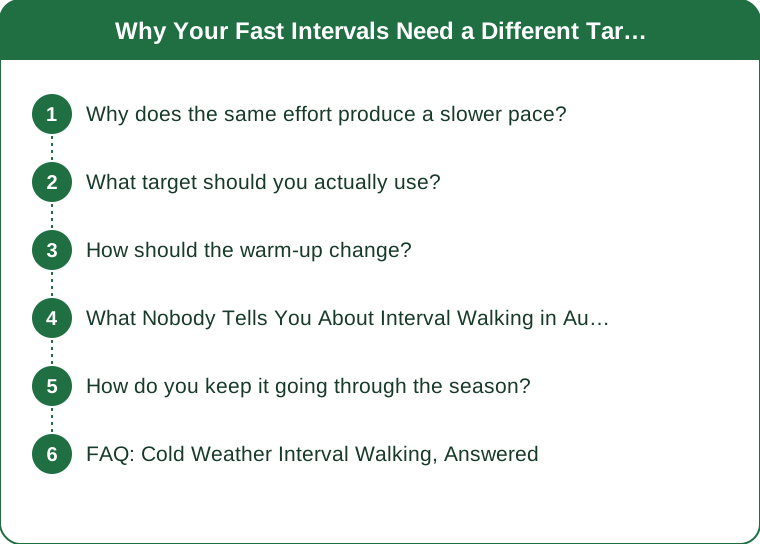
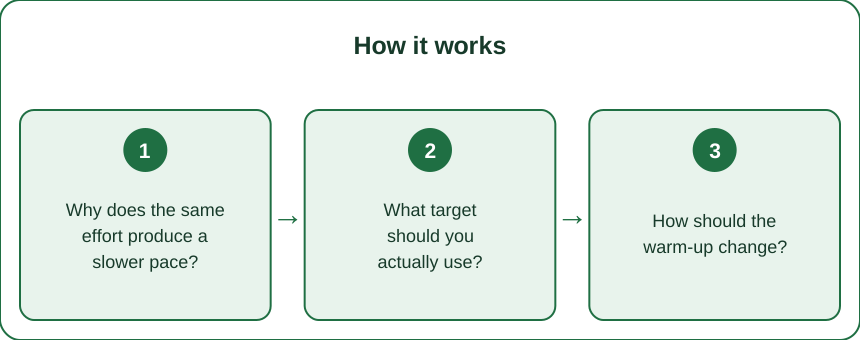
Why does the same effort produce a slower pace?
Layers cost energy. Extra clothing adds weight, restricts arm swing, and increases the work of moving limbs. On a cold day with a jacket, gloves, and a hat, this is not trivial.
Cold muscle is less efficient early on. Force production and elastic return are both reduced until tissue warms, and a thirty-minute interval walk spends a meaningful fraction of its time in that state.
Footing changes. Wet leaves, frost, and mud all reduce push-off efficiency and cause a subconscious shortening of stride.
Wind is the underrated variable. A headwind of 15 mph raises the energy cost of walking substantially, and it is the single largest reason an autumn pace target becomes unachievable.
Breathing cold dry air is slightly more work and, for people with any airway sensitivity, noticeably so.
And you started colder. In summer you begin a session already warm. In autumn the first five minutes of a thirty-minute session are effectively a warm-up rather than training.
What target should you actually use?
Perceived exertion, expressed in speech. During fast intervals you should be able to speak in short phrases but not comfortably converse. That test is temperature-independent.
If you use a number scale, aim for roughly 6 to 7 out of 10 on fast intervals and 3 to 4 on the slow ones. Those numbers hold across seasons in a way that pace does not.
Heart rate is usable but needs interpretation. In cold weather resting and early-session heart rate can run lower, and the drift over a session is smaller, so a fixed heart rate zone can have you working harder than intended early on.
Keep the interval structure identical. Three minutes fast, three minutes easy, repeated five times, is the pattern the research is built on. Change the target, not the structure.
Track duration and consistency rather than pace. Sessions completed per week is the number that predicts outcomes, and it is the one that collapses when people chase unachievable paces.
And record the conditions alongside the session. A note saying windy or icy makes a slow session interpretable three weeks later instead of demoralising.
How should the warm-up change?
Extend it to five to eight minutes before the first fast interval. In summer two minutes is enough; in autumn it is not.
Walk the first interval as an extra easy one if you started cold. Losing one fast interval to a proper warm-up is a better trade than doing the first one badly.
Move indoors first if you can. Two minutes of marching, hip circles, and calf raises in a warm hallway before you step outside changes the first ten minutes substantially.
Dress for ten minutes in, not for the doorstep. The classic error is dressing for how cold it feels standing still, then overheating and either sweating heavily or stopping to remove layers.
Protect the extremities specifically. Hands and ears drive most of the discomfort that shortens sessions, and gloves and a hat are cheaper than losing the habit.
And keep the cool-down. Stopping abruptly in cold weather cools you fast, and the walk home in wet clothing is where people get properly chilled.

What Nobody Tells You About Interval Walking in Autumn
Darkness ends more sessions than cold does. Route safety and visibility are the practical limiter from October, and people who solve lighting keep the habit while people who solve clothing often do not.
Treadmill intervals are not equivalent, but they are close enough. The belt reduces the propulsive demand slightly, so add one percent incline and the effort matches outdoor walking reasonably well.
Cold weather sessions feel harder afterwards than during. The post-session chill from damp base layers is what people remember, and it is the most common reason a habit quietly stops. A dry layer to change into afterwards is a surprisingly high-value item.
Wet leaves are more slippery than ice on the kind of paths people use for this, and autumn falls cluster on downhill sections with leaf cover.
Your slow intervals matter more than you think. In cold weather people walk the recovery intervals too fast because they are cold, which compromises the contrast the method depends on.
And the benefits of the method do not require a specific pace. The published outcomes come from the contrast between hard and easy, sustained over months. A slower winter is not a worse winter.
How do you keep it going through the season?
Fix the route before you fix the training. A lit, well-drained, and safe route that you can use in the dark is the foundation, and it may not be your summer route.
Move the session earlier in the day if daylight allows. Lunchtime interval walks survive autumn far better than evening ones.
Have an indoor version ready. A treadmill or even stair intervals covers the days when the weather genuinely makes it unsafe.
Reduce frequency before you reduce quality. Three good sessions beat five poor ones, and it is easier to rebuild from three than from zero.
Set a completion target rather than a pace target for the season. Twelve sessions in November is a goal you can actually hit.
This is general information, not medical advice. Chest tightness, unusual breathlessness, or dizziness in cold weather warrants medical assessment rather than pushing through.
FAQ: Cold Weather Interval Walking, Answered
How much slower should my fast intervals be in autumn?
Five to ten percent slower for the same effort is normal, and more in wind. Judge by breathing rather than by pace.
Should I use heart rate zones in cold weather?
With caution. Cold can lower early-session heart rate, so a fixed zone can mean working harder than intended. Perceived exertion is more reliable.
Is treadmill interval walking equivalent?
Close enough with a one percent incline. Structure and effort matter far more than the surface.
How do I stop my hands and ears getting cold?
Gloves and a hat, put on before you start rather than once you are cold. Extremity discomfort ends more sessions than general cold does.
Do I need to change the three-minute interval structure?
No. Keep the structure and change the intensity target. The contrast between hard and easy is what the method depends on.
TL;DR:
- Layers, cold muscle, wind, and footing all slow your pace for identical effort - five to ten percent is normal.
- Use perceived exertion as your target: short phrases only during fast intervals, comfortable conversation during easy ones.
- Heart rate zones can mislead in the cold because early-session heart rate runs lower and drifts less.
- Extend the warm-up to five to eight minutes and dress for ten minutes in, not for the doorstep.
- Fix the route and the lighting first - darkness ends more autumn sessions than cold does.
Keep the three-minutes-hard, three-minutes-easy structure and change only the intensity target. The contrast is what the method depends on.
See It in Motion
Seen here: High Waist Jogger Sweatpants with Pockets — shop it on bubblelime.com
Keep Reading
This article is for general informational purposes only and is not medical advice. Always consult a qualified health professional for guidance specific to you.