How to Restructure Interval Walking for Shorter Days
Quick Answer: Interval walking keeps its benefits at shorter durations if you preserve the intensity contrast and the number of fast intervals rather than the total time. A 20-minute session with five fast intervals delivers most of what a 30-minute session with seven does — and it fits into the daylight you actually have.
The interval walking session you have been doing since spring assumed a 7 p.m. that was still light. It is not anymore, and by November it will be dark before you leave work.
The usual response is to skip it on the days it does not fit, which turns three sessions a week into one and then into none by December.
The better response is to rebuild the session around the constraint.

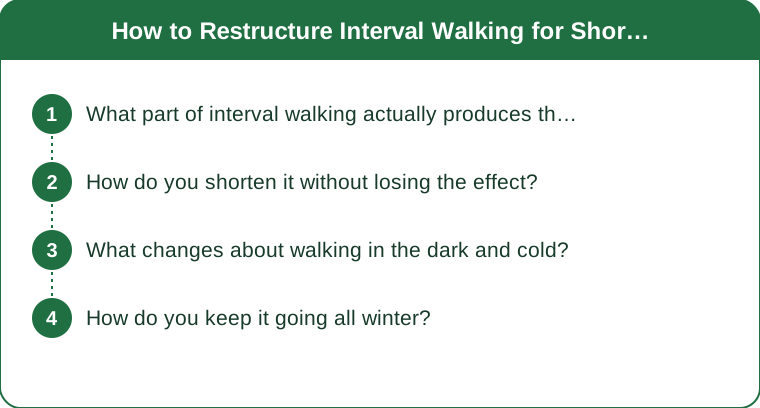
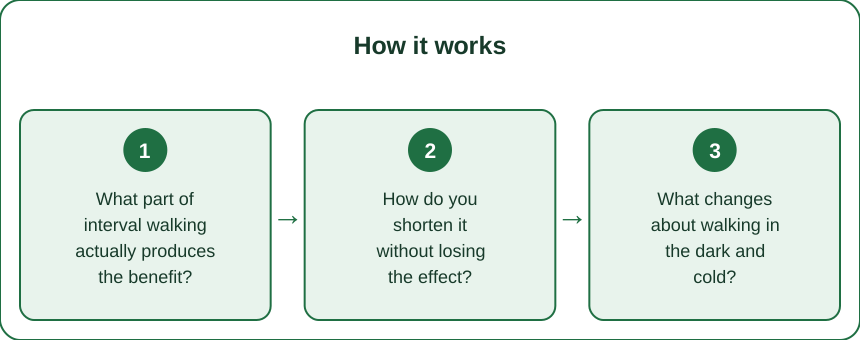
What part of interval walking actually produces the benefit?
Worth knowing before you cut anything, so you cut the right thing.
The protocol that most interval walking programs derive from alternates three minutes of fast walking with three minutes of slow walking, repeated for about 30 minutes, several times a week. The studies behind it found meaningful improvements in leg strength, peak aerobic capacity, and blood pressure in middle-aged and older adults — improvements that continuous moderate walking did not produce at the same total volume.
The mechanism is the contrast, not the duration. The fast intervals need to be genuinely hard — around a 6 or 7 out of 10 perceived exertion, a pace where holding a conversation is difficult. The slow intervals need to be genuinely easy, because the recovery is what allows the next fast interval to be hard enough.
What this means for shortening: the fast intervals are the active ingredient. Total session time is the least important variable. A session that keeps five hard intervals and cuts the warm-up and cool-down preserves far more than one that keeps the duration and lets the intensity drift down.
How do you shorten it without losing the effect?
Three ways to restructure, in order of preference.
Option 1: Fewer intervals, same structure. Keep 3 minutes fast / 3 minutes slow, do four rounds instead of five, and shorten the warm-up to three minutes. Total: 27 minutes down to about 21. This is the cleanest cut because nothing about the session changes except the number of repetitions.
Option 2: Shorter intervals, higher intensity. Move to 2 minutes fast / 2 minutes slow and push the fast intervals harder — a 7 to 8 out of 10 rather than 6 to 7. Six rounds is 24 minutes and delivers a comparable total stimulus with a different shape. This works well for people who have been doing the standard protocol for months and have adapted to it.
Option 3: Split the session. Two 12-minute blocks — one at lunch, one after work. Accumulated exercise produces comparable cardiovascular benefit to continuous exercise at equal total volume, and this option is often the most practical one for people whose daylight is confined to a lunch break.
What not to do: keep the duration and let the fast intervals become moderate. A 30-minute walk at a uniform moderate pace is a fine thing to do and it is a different exercise that produces different results. If it is going to become that, do it deliberately rather than by drift.

What changes about walking in the dark and cold?
The session structure is only half the problem.
Visibility is a genuine safety issue and it is easy to underestimate how invisible dark clothing is to a driver at dusk. Reflective material on moving parts — ankles and wrists — is far more visible than a static reflective panel, because motion is what catches the eye. A headlamp or a clip light matters as much for being seen as for seeing.
Surfaces change. Wet leaves over pavement are more slippery than mud and behave unpredictably on a downhill. Fast intervals on a leaf-covered path are a genuine fall risk. Shift the fast intervals onto the cleanest, most predictable stretch of your route and take the slow intervals through the messy parts.
Route choice should change with the season. Loops near home beat point-to-point routes when it is dark. Lit paths beat scenic ones. Familiar beats new, because you know where the uneven paving is without seeing it.
Warm-up needs to be longer. Cold muscle in the first fast interval is where strains come from. Five minutes of easy walking before the first fast interval, minimum, and more if it is below 45°F.
And dress for the intervals, not the walk. The fast portions generate substantial heat and the slow portions do not, which is the specific problem with interval work in the cold. A layer you can open at the neck, or gloves you can take off, handles the swing better than picking one temperature and committing to it.
How do you keep it going all winter?
The habit question, which is ultimately the one that determines whether any of this matters.
Move it to daylight if you possibly can. A lunchtime session in November is a completely different experience from a 6 p.m. one, and midday light exposure has real benefits for mood and sleep on top of the exercise itself. This is worth restructuring your day around more than most people think.
Have an indoor version ready. Stairs work extremely well for this — three minutes of stair climbing is a perfectly good fast interval, and it is weather-proof and well lit. A treadmill version works too, using incline for the fast intervals rather than speed, which is easier on joints and produces a comparable cardiovascular response.
Set the floor. On the worst days, one warm-up plus two fast intervals counts as a completed session. Twelve minutes. The value is not in the training stimulus of that particular day; it is that the habit never registers a zero, and habits die from zeros rather than from short sessions.
Track something that keeps improving. As daylight shrinks, motivation needs a source other than the weather. The distance covered during fast intervals, or your heart rate at the end of interval three, both keep moving through winter and both give you a reason to show up.
And plan the transition now, in early autumn, rather than in November when it is already dark and cold and the habit has already had three bad weeks. The version of this you set up in September is the version you will still be doing in February.
This is general information, not medical advice.
TL;DR:
- The active ingredient is the intensity contrast, not the total duration — cut intervals, never intensity.
- Four rounds of 3-on / 3-off in 21 minutes preserves most of a 30-minute session’s effect.
- Alternatives: shorter and harder intervals (2 on / 2 off at 7–8 out of 10), or two 12-minute blocks split across the day.
- Put fast intervals on the cleanest stretch of route, warm up for at least five minutes, and use reflective material on ankles and wrists.
- Have a stair or treadmill-incline version ready, and set a two-interval floor for bad days.
- Move the session to daylight if at all possible — a lunchtime walk in November is a different experience entirely.
See It in Motion
Seen here: Super High Waist Embossed Yoga Leggings with Inner Pocket — shop it on bubblelime.com
Keep Reading
This article is for general informational purposes only and is not medical advice. Always consult a qualified health professional for guidance specific to you.