Why Your Interval Walking Falls Apart When You Bring a Friend
Quick Answer: Interval walking depends on hitting a genuinely hard 3-minute effort, and conversation makes that structurally impossible — talking caps your effort at roughly the top of the easy zone. Walking with a partner also averages two different fitness levels into one pace that suits neither. The fix is not to walk alone: agree on silence during fast intervals, talk only during recovery, and let each person pick their own pace within the same clock.
You have been doing interval walking for six weeks. Three minutes fast, three minutes easy, five rounds, and it has been working.
Then a friend joins you, you have a lovely walk, and you get home to find your average heart rate was fourteen beats lower than usual.
Nothing went wrong socially. The workout just quietly turned into a walk, and there are three separate mechanisms doing it.

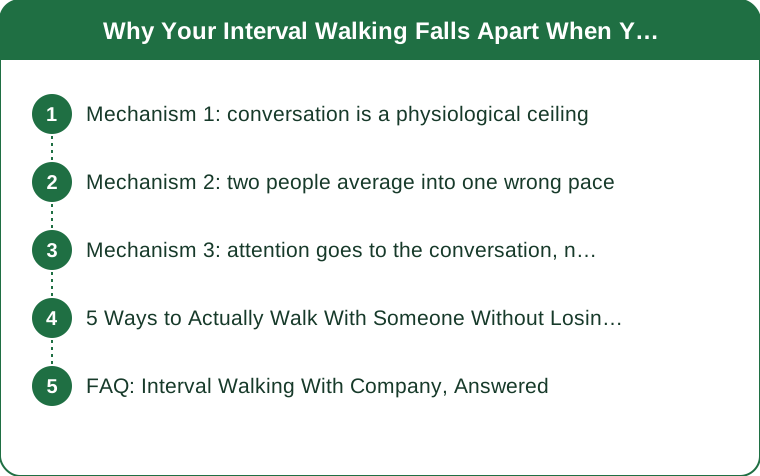
Mechanism 1: conversation is a physiological ceiling
This is not a metaphor. The talk test is a validated method for estimating exercise intensity, used in clinical settings precisely because it is reliable.
The logic is simple: speaking requires controlled exhalation. Above a certain intensity, your breathing rate and depth make continuous speech physically impossible. That threshold sits, for most people, right around the first ventilatory threshold — which is roughly the top of what exercise scientists call moderate intensity.
Japanese interval walking asks for fast intervals at approximately 70 to 85 percent of peak effort, which sits above that threshold. You should be able to say a few words, not a sentence.
So if you are holding a conversation during the fast interval, you are by definition below the intensity the protocol requires. Not slightly below. Below the boundary that defines the zone.
This is the whole problem in one sentence: you cannot chat and do the interval. One of them has to give.
Mechanism 2: two people average into one wrong pace
Even in silence, pairing creates a pace problem.
When two people walk together, they synchronise. This happens automatically and largely unconsciously — gait entrainment is well documented, and people match cadence within a minute or two of walking side by side.
The pace they settle on is not the average of what each would choose. It skews toward the slower person, because the faster walker adjusts more easily than the slower one accelerates.
Result: the fitter partner works at maybe 60 percent of their capacity, which is below the training zone. The less fit partner works at 90 percent, which is above the intended zone and unsustainable across five rounds.
Neither person gets the workout. One is under-stimulated and one is over-cooked, and both of them think they did interval walking.
The kicker: this gets worse over the session. As the less fit partner fatigues, the gap widens, and rounds four and five are typically the most mismatched of all.

Mechanism 3: attention goes to the conversation, not the effort
Interval walking works because you are paying attention to intensity. The protocol is not really about the three minutes; it is about hitting a specific effort within them.
Effort regulation is a cognitive task. You are monitoring breathing, leg fatigue, cadence and time, and adjusting continuously.
Conversation occupies exactly the same attentional resources. Something has to be deprioritised, and it is never the conversation, because social attention is prioritised automatically.
What this looks like in practice: you start the fast interval strongly, the conversation picks up around ninety seconds in, and by the two-minute mark you have drifted down a full gear without noticing. Heart rate data from people who track this consistently shows the same shape — a good first ninety seconds and a fading second half, specifically on social walks.
Why the timer does not save you: the timer tells you when, not how hard. It will faithfully beep at three minutes regardless of whether you spent them at 78 percent or 55 percent.
5 Ways to Actually Walk With Someone Without Losing the Workout
1. Silent fast, social easy. Agree explicitly: no talking during the three fast minutes, talk freely during the three easy ones. This is the single highest-value fix, it preserves the entire social point of the walk, and after two sessions it stops feeling awkward. You still get fifteen minutes of conversation across a thirty-minute session.
2. Same clock, separate paces. Start and stop intervals together, but each person walks their own fast pace. You will separate by thirty or forty metres during fast intervals and come back together during recovery. This is the cleanest solution for mismatched fitness and it looks stranger than it feels.
3. Loop routes instead of out-and-back. On a loop of 400 to 800 metres, separation never becomes navigational. You are always within sight, you rejoin naturally, and nobody has to wait at a corner.
4. Let the slower partner start the fast interval first. A ten-second head start turns a widening gap into a stable one, and it removes the low-grade pressure that makes the less fit partner overreach.
5. Take one intentionally social walk a week. Not an interval session — a walk. Protecting one genuinely conversational walk removes the pressure on the interval sessions to also be social time, and it is usually the change that makes the whole arrangement stick.
FAQ: Interval Walking With Company, Answered
Does walking with a dog cause the same problem?
Partly. No conversation, so mechanism one disappears. But dogs impose stop-start pacing that fragments fast intervals badly. A dog on a short lead who has already been allowed to sniff for ten minutes beforehand works far better than a dog starting fresh.
What if my partner is much fitter than me?
Use the same clock, separate paces approach, and resist matching them. Your 80 percent is the training stimulus, not their pace. Matching a fitter partner is the most common way people over-reach and then abandon the habit in week three.
Is a social walk still worth doing?
Absolutely — just count it as a walk rather than as a training session. Sixty minutes of easy walking with a friend has real value for cardiovascular health, mood and consistency. It is simply not interval training, and the mistake is only in the label.
TL;DR:
- Conversation caps your intensity below the interval zone by definition — the talk test is a validated threshold, not a rule of thumb.
- Two people entrain to one pace that skews slow, so the fitter partner under-trains and the less fit one over-reaches.
- Effort regulation and conversation compete for the same attention, which is why fast intervals fade after about ninety seconds on social walks.
- Fix it with silence during fast intervals and talking during recovery, or same clock with separate paces on a loop route.
- Keep one genuinely social walk a week and stop asking your interval sessions to do two jobs.
The friend is not the problem. Asking three minutes to be both hard and chatty is.
See It in Motion
Seen here: High Waist 8” Yoga Shorts — shop similar styles on bubblelime.com
Keep Reading
This article is for general informational purposes only and is not medical advice. Always consult a qualified health professional for guidance specific to you.