Why Your Fast Intervals Get Slower as the Session Goes On
Quick Answer: Your fast intervals slow down because the first two or three were faster than a sustainable effort, so you accumulated fatigue you never recover from within a three-minute rest. Japanese interval walking is designed around a repeatable effort — roughly 70 percent of peak capacity — not a maximal one. Start the first interval feeling almost too easy and the last one will match the first.
Interval one: 6.2 km/h and comfortable.
Interval eight: 5.1 km/h and you are working harder than you were at the start.
The protocol did not get harder. Your first interval was written a cheque the rest of the session had to pay.

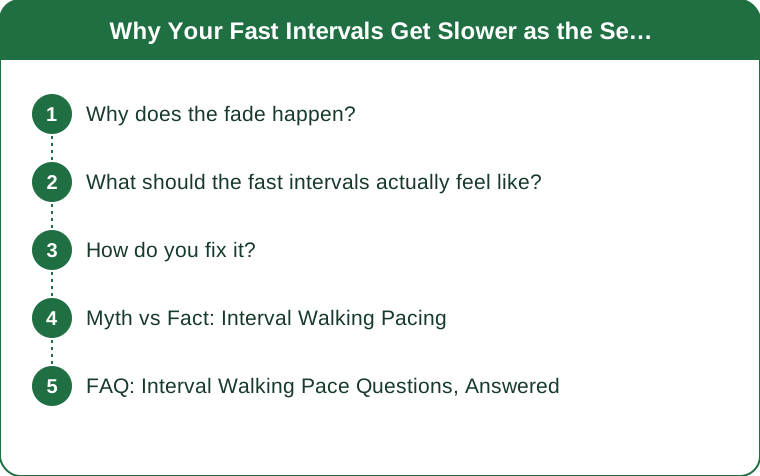
Why does the fade happen?
Three mechanisms, and the first is by far the largest.
The opening intervals were above your sustainable effort. Fresh, motivated and with no accumulated fatigue, the first fast block feels easy at a pace that is genuinely too fast for eight repetitions. The cost does not appear until interval four or five, which is why the mistake is invisible while you are making it.
Recovery is incomplete between blocks. The slow interval in Japanese interval walking is a genuine recovery period, but three minutes at an easy pace does not fully clear the fatigue from an effort that was too hard. Each interval then starts from a slightly worse position, and the deficit compounds across the session.
Cardiac drift adds to it. Over a 30-minute session, particularly in warm weather, heart rate rises at a fixed workload because of fluid loss and rising core temperature. Meaning that even holding the same pace demands progressively more, and if you are pacing by feel, that translates into a slowing pace.
Warm weather makes all three worse. Late summer sessions fade more sharply than autumn ones, and people frequently interpret an August fade as lost fitness when it is largely the conditions.
A modest fade is normal. Losing a small amount of pace across a session is expected. A drop of more than about 10 percent from first to last interval usually indicates the opening was too hard.
What should the fast intervals actually feel like?
Considerably easier than most people make them, particularly at the start.
The Japanese interval walking protocol targets around 70 percent of peak aerobic capacity during the fast blocks — brisk, purposeful, and clearly harder than a stroll, but not an all-out push. It is designed to be repeated many times.
The conversation test is the practical version. During a fast interval you should be able to speak in short phrases but not comfortable full sentences. If you cannot speak at all, you are above the intended intensity. If you can chat easily, you are below it.
Breathing should be noticeably elevated and controlled. Panting is a sign you have overshot.
Your first interval should feel almost restrained. This is the single most useful cue. If interval one feels like the right effort, it is probably too hard, because your perception of effort is depressed by freshness.
Perceived effort should rise across the session at constant pace — that is normal and expected. What should not happen is pace collapsing to keep effort constant.

How do you fix it?
Four adjustments, in order of impact.
1. Deliberately hold back for the first three intervals. Set a pace you are confident you could repeat ten times, and refuse to exceed it early even though it feels too easy. This alone resolves most fades.
2. Pace by a number, not by feel, until you calibrate. A watch pace, a treadmill speed or a known route segment gives you an external check that your perception cannot override. After a few sessions the feel recalibrates and you can go back to effort.
3. Use the slow intervals properly. Many people walk the recovery blocks too fast, which prevents recovery without adding useful stimulus. The slow block should be genuinely easy — a comfortable stroll where breathing settles substantially.
4. Account for the conditions rather than fighting them. On a hot, humid day, hold the same effort and accept a slower pace. Chasing your cool-weather pace in August is how a session turns into a struggle.
Track first-to-last interval pace as your metric. If the gap is under about 5 percent, your pacing is well judged. If it is over 10 percent, start easier next time. This single number is more useful than average pace for judging a session.
Expect your numbers to improve on their own in the next few weeks. As temperatures drop through autumn, the same effort produces a faster pace and the fade shrinks. That is weather, not a training breakthrough — enjoy it without rewriting your plan around it.
Myth vs Fact: Interval Walking Pacing
Myth: The fast intervals should be as fast as you can walk. Fact: The protocol is built around a repeatable moderate-hard effort. Maximal intervals change the session into something else and produce worse adherence.
Myth: A fade means you are unfit. Fact: It most often means you started too fast. Even well-trained people fade badly from an over-ambitious opening.
Myth: You should push harder on the last interval to finish strong. Fact: Even pacing produces more total quality work. A big final effort usually just confirms you had headroom you should have spread across the session.
Myth: If the fast intervals feel easy, they are not working. Fact: Around 70 percent of peak capacity is meant to feel moderately hard and sustainable. Sessions that feel brutal are the ones people abandon after three weeks.
Myth: Recovery intervals are wasted time. Fact: They are what allow the fast blocks to be repeated at quality. Compressing or speeding them up degrades the whole session.
FAQ: Interval Walking Pace Questions, Answered
How much fade is acceptable?
Under about 5 percent from first to last interval suggests good pacing. Over 10 percent means the opening was too fast.
Should I use heart rate to pace?
It is useful but lags — heart rate takes a minute or more to catch up with a three-minute interval, and it drifts upward across a session. Pace or perceived effort is more practical, with heart rate as a cross-check.
Why is it worse on a treadmill?
Fixed speed removes the small unconscious adjustments you make outdoors, plus heat builds up without airflow. Many people find treadmill intervals feel harder at the same nominal speed.
Does the fade matter if I complete the session?
Mildly. Even pacing produces more total work at the target intensity, which is what drives the adaptations. A completed session with a fade is still worthwhile.
How long until my pace improves?
Most people see measurable improvement within four to eight weeks of consistent sessions, though some of any autumn improvement is the cooler weather.
Can I do more than the standard number of intervals?
Build gradually if so, and expect pacing to matter even more. The longer the session, the more expensive an over-fast opening becomes.
TL;DR:
- The fade is almost always caused by the first two or three intervals being too fast.
- Target a repeatable moderate-hard effort — short phrases, not full sentences, not panting.
- Your first interval should feel almost restrained. If it feels right, it is probably too hard.
- Use the slow blocks as genuine recovery, not a slightly slower fast block.
- Track first-to-last interval pace. Under 5 percent is well judged; over 10 percent means start easier.
And expect the numbers to improve on their own as the weather cools. That part is free.
See It in Motion
Seen here: High Waist Jogger Sweatpants with Pockets — shop it on bubblelime.com
Keep Reading
This article is for general informational purposes only and is not medical advice. Always consult a qualified health professional for guidance specific to you.