Why Your Interval Walking Gets Easier on the Same Route Without Getting Faster
Quick Answer: On a route you know well, you stop pacing by effort and start pacing by landmark - reaching the same corner in the same three minutes, whatever your legs are doing. Because your fitness improved, hitting that landmark now takes less effort, so intensity drops while the session feels identical. Fix it by pacing to heart rate or breathing rather than to geography, and rotate routes every three or four weeks.
The route has not changed, the timings have not changed, and something has.
The fast intervals do not have the bite they had a month ago, and your pace has not improved to explain it.

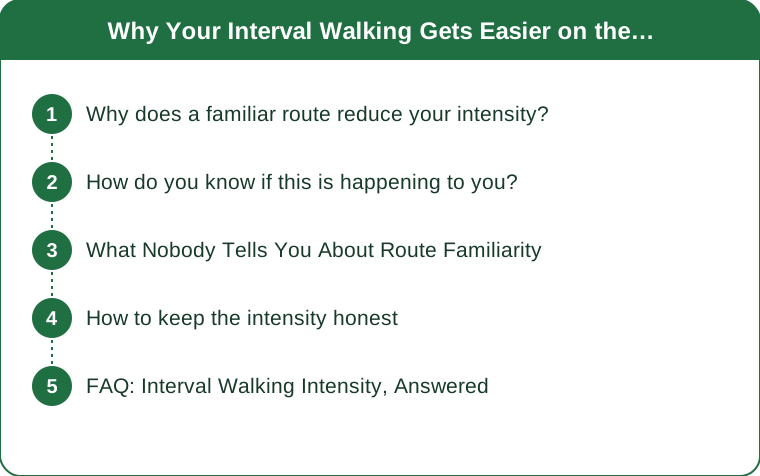
Why does a familiar route reduce your intensity?
Because landmarks quietly replace effort as your pacing cue. After a few weeks you know that the fast interval ends at the second lamppost, and you unconsciously arrange your effort to arrive there on time rather than to hit a target intensity.
As fitness improves, arriving at that lamppost gets easier. The distance is fixed, so improved fitness converts directly into reduced effort rather than into a faster interval - the exact opposite of what interval walking is meant to produce.
Familiarity also lowers arousal. Novel environments raise heart rate slightly through attention and alertness alone, and a route you have walked ninety times raises it not at all.
And your gait becomes efficient on known ground. You stop making the small adjustments that unfamiliar surfaces and camber demand, and efficiency in this context means less work for the same speed.
None of this is visible in a training log. Same route, same duration, same intervals - it looks like consistency and it functions like a gradual taper.
Japanese interval walking depends on the fast intervals genuinely reaching a hard effort, usually described as around 70 percent of peak capacity, and the whole benefit rests on that intensity actually being reached rather than nominally scheduled.
How do you know if this is happening to you?
The clearest sign is the talk test drifting. If you could barely string a sentence together during fast intervals a month ago and now you comfortably could, the intensity has fallen regardless of what the clock says.
Heart rate that peaks lower on the same route is the objective version of the same thing. If your fast intervals used to top out around 75 percent of max and now reach 65 percent, that is the drift in numbers.
Recovery that feels too easy is another marker. The slow intervals in this format should feel like genuine recovery from something, not like a continuation of a walk.
No progression in pace over four or more weeks while the sessions feel manageable is the summary version. Something should be improving - either the pace at the same effort or the effort at the same pace - and if neither is, the intensity has settled.
Try the direct test: walk your usual route in reverse. If the fast intervals suddenly feel harder at the same nominal effort, you were pacing by landmark rather than by effort.
One honest exception: if you are deliberately in an easy phase or recovering from illness, a lower intensity is correct rather than a problem. This matters when the goal is progression and you are not getting it.

What Nobody Tells You About Route Familiarity
Direction matters more than distance. Walking a familiar loop in reverse changes the camber, the gradient profile, and every landmark cue at once, and it costs nothing. Most people never try it.
Time of day changes the physiological cost meaningfully. Late summer heat and humidity raise heart rate at the same walking pace, so a morning route and an evening route are genuinely different sessions even in the same location.
Surface change is a bigger lever than gradient for walking. Moving from pavement to gravel, grass, or trail raises energy cost measurably at the same speed, without requiring you to find a hill.
Music tempo affects walking cadence more than most people expect, and using the same playlist on the same route compounds the landmark effect - two cues both telling you to do exactly what you did last time.
Walking with someone else pins your pace to theirs, which is usually below your interval target. Social walks are worth doing and they are not interval sessions.
Treadmills have the opposite problem. Their pacing is externally imposed, so intensity does not drift down - but because the belt does the pacing, the same speed becomes easier as fitness improves and nobody adjusts it either. Both settings need effort-based checks, just for different reasons.
How to keep the intensity honest
Pace to effort, not to geography. Set a target of roughly 70 percent of your peak effort on the fast intervals - hard enough that speaking in full sentences is difficult - and let the landmarks fall wherever they fall.
Use a timer that does not know where you are. Three minutes fast, three minutes slow, repeated 5 times, driven purely by the clock. If the fast interval ends mid-hill, so be it - that is the point.
Rotate routes every three to four weeks. You do not need many; two or three that alternate is enough to break the landmark association before it hardens.
Do a monthly effort audit. Same route, same intervals, record heart rate or perceived effort, and compare with last month. If effort dropped, raise the pace target rather than the duration.
Change one variable at a time when you do change something - surface, direction, or time of day - so you can tell what produced the difference.
And progress the fast intervals specifically. The slow intervals are recovery and should stay comfortable; if your whole session is drifting toward one moderate pace, you have a brisk walk rather than an interval session, and the two produce different results.
As mornings cool over the next few weeks, expect your heart rate at the same pace to drop slightly. That is the weather, not fitness - which is another reason to pace by effort and audit monthly.
FAQ: Interval Walking Intensity, Answered
How hard should the fast intervals feel?
Around 70 percent of your peak effort - hard enough that full sentences are difficult but you are not gasping. If you can talk comfortably, the interval is not doing its job.
How often should I change my route?
Every three or four weeks is enough. You do not need endless variety; two or three routes in rotation prevents the landmark association from setting in.
Does walking the same route in reverse really help?
Yes, and it is the cheapest fix available. It changes camber, gradient order, and every pacing landmark at once, which is usually enough to reveal whether you were pacing by geography.
Should the slow intervals get faster too?
No. They are recovery and should stay genuinely easy. If both intervals drift toward the same moderate pace, you have converted an interval session into a steady walk.
Is a treadmill better for keeping intensity honest?
It removes the landmark problem but adds its own - the belt speed stays where you set it, so it becomes easier as you improve unless you deliberately raise it. Both settings need a monthly effort check.
Why does my heart rate drop on the same route in cooler weather?
Heat raises heart rate at a given pace, so a cooler morning lowers it without any fitness change. Compare like with like, or pace to perceived effort instead.
How do I know the programme is still working?
Either your pace at the same effort improves, or your effort at the same pace falls. If neither changes over four weeks, the intensity has settled and the fast intervals need raising.
TL;DR:
- Familiar routes let landmarks replace effort as your pacing cue, so improved fitness turns into less effort rather than more speed.
- The talk test drifting - being able to speak comfortably during fast intervals - is the earliest sign.
- Walking the route in reverse is the cheapest diagnostic and the cheapest fix.
- Pace fast intervals to roughly 70 percent effort using a timer, and let the landmarks fall where they fall.
- Rotate two or three routes every three to four weeks and audit effort monthly.
Keep the slow intervals genuinely easy. If both paces converge, you have a brisk walk rather than an interval session.
See It in Motion
Seen here: High Waist Yoga Leggings with Side Pockets — shop it on bubblelime.com
Keep Reading
This article is for general informational purposes only and is not medical advice. Always consult a qualified health professional for guidance specific to you.