Why Music Changes Your Interval Walking Pace More Than You Realise
Quick Answer: People spontaneously synchronise their steps to musical tempo, often without noticing. In interval walking, that means a playlist with uniform tempo flattens the difference between your fast and slow intervals - the fast ones slow down and the slow ones speed up. Since the method depends on genuine contrast between intensities, matching tempo to the interval rather than to your mood is one of the simplest ways to make sessions more effective.
You have been doing three-minute fast, three-minute slow intervals for two months, and the heart rate difference between them has quietly shrunk to almost nothing.

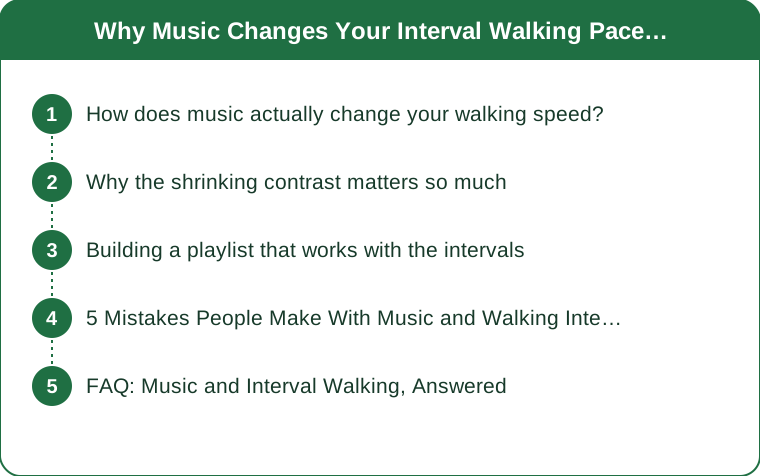
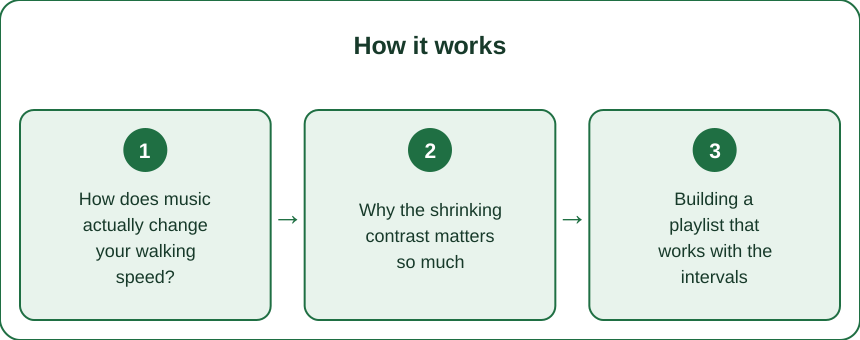
How does music actually change your walking speed?
Through a well-documented tendency to move in time with a beat.
Humans spontaneously synchronise movement to rhythm. This entrainment happens largely automatically, and walking cadence is particularly susceptible because stepping is already a rhythmic activity.
Music tempo pulls cadence toward it. A track at 120 beats per minute encourages roughly 120 steps per minute, and most people drift toward the beat without deciding to.
Cadence and speed are linked but not identical. You can walk faster by taking longer steps rather than more frequent ones, but in practice most people change cadence rather than stride length when the tempo changes.
Music also reduces perceived effort. Listening to music during exercise is consistently associated with lower ratings of perceived exertion at the same workload, which means a fast interval can feel easier than it is - useful for output, less useful for pacing by feel.
The interval walking problem is specific. Japanese interval walking depends on a genuine contrast between fast intervals at a high effort and slow intervals at a comfortable one. A uniform playlist erodes that contrast from both ends simultaneously.
Why the shrinking contrast matters so much
The whole method rests on the difference between the two intensities.
Interval walking works because of the intensity contrast, with fast intervals at an effort where holding a conversation becomes difficult, and slow intervals genuinely easy enough to recover.
If fast intervals slow down, the session stops providing the higher-intensity stimulus that drives the adaptations the method is known for.
If slow intervals speed up, you do not recover adequately, which means the following fast interval is worse and the session becomes moderate-intensity throughout - the exact thing intervals were designed to avoid.
Both happen at once with a uniform playlist, which is why the effect is larger than it sounds. You lose intensity at the top and recovery at the bottom.
How to spot it in your own data: if the heart rate difference between your fast and slow intervals has narrowed over weeks without a deliberate change, tempo is a very plausible cause. It is also worth checking that your fast intervals still feel genuinely hard rather than merely purposeful.
The plateau this produces is the classic one: interval walking that stops producing progress after a couple of months, without any obvious change in the plan.

Building a playlist that works with the intervals
Practical and easier than it sounds.
Match tempo to interval, not to preference. Faster tracks for fast intervals, slower ones for recovery. This single change restores most of the lost contrast.
Useful rough ranges: something in the region of 130-150 beats per minute suits brisk walking for many people, and 100-115 suits recovery. Individual comfortable cadence varies considerably, so use these as starting points and adjust.
Find your own cadence first. Count your steps for 30 seconds at your natural brisk pace and double it. Choosing music around that number is far more effective than adopting someone else’s.
Match track length to interval length. If your intervals are three minutes, tracks of roughly that length give you an automatic timer, and the transitions cue the change without you needing to watch a clock.
Alternatively, use silence for recovery. Music for fast intervals only creates an unmistakable contrast and gives your attention a rest as well.
Beware of shuffle. A random playlist during a structured session is precisely the problem this fixes. Build a fixed sequence.
And podcasts are a mixed case. Speech has no consistent beat, which avoids the entrainment problem entirely, but it also removes the pacing help and tends to make people drift toward a uniform comfortable pace. Fine for steady walks, less useful for intervals.
5 Mistakes People Make With Music and Walking Intervals
1. Using one playlist for the whole session. The most common error, and it flattens the contrast from both directions at once. Two playlists, or one carefully sequenced, solves it.
2. Choosing music by mood rather than tempo. An energising slow track will not drive a fast interval, and a fast track during recovery keeps you from recovering. Tempo does the work, not vibe.
3. Letting shuffle run during a structured session. Randomised tempo during intervals is worse than no music at all, because it actively pulls your pace in the wrong direction at unpredictable moments.
4. Trusting perceived effort while listening. Music reliably lowers perceived exertion, which means “this feels hard enough” is a less reliable gauge than usual. Check heart rate or use a talk test during at least one interval per session.
5. Ignoring safety in the name of pacing. Volume high enough to drive cadence is often high enough to mask traffic. One earbud out near roads, or bone-conduction headphones, keeps the pacing benefit without the risk - and this matters more as evenings darken in early autumn.
And the one people find surprising: the same playlist stops working as you get fitter. A tempo that drove a genuinely hard interval in July may be comfortable by September, and updating it is part of progression rather than a nicety.
FAQ: Music and Interval Walking, Answered
Does music really change how fast I walk?
Yes. People spontaneously synchronise their steps to musical tempo, largely automatically. Cadence drifts toward the beat, which is helpful when the tempo matches the interval and unhelpful when it does not.
What tempo should I use for fast intervals?
Around 130-150 beats per minute suits brisk walking for many people, but individual cadence varies. Count your own steps for 30 seconds at your brisk pace, double it, and choose music near that number.
Should I listen to music during recovery intervals?
Either slower tracks or silence. What does not work is keeping fast music running, because it keeps your cadence elevated and prevents the recovery the next fast interval depends on.
Are podcasts a good alternative?
For steady walks, yes - speech has no beat, so there is no entrainment effect. For structured intervals they tend to produce a uniform comfortable pace, which is exactly what interval walking is trying to avoid.
Why has my interval walking stopped producing results?
One very common cause is a shrinking gap between fast and slow intervals, and uniform-tempo music is a frequent culprit. Check whether your heart rate difference between intervals has narrowed over recent weeks.
TL;DR:
- People synchronise steps to musical tempo automatically, so your playlist is pacing you whether you intend it or not.
- A uniform playlist slows your fast intervals and speeds up your recovery ones at the same time.
- Match tempo to interval - roughly 130-150 bpm for fast, 100-115 for recovery, adjusted to your own cadence.
- Match track length to interval length and never use shuffle during a structured session.
- Music lowers perceived effort, so verify at least one interval per session with heart rate or a talk test.
The plan did not stop working. Your playlist has been quietly negotiating your pace down for two months.
See It in Motion
Seen here: Super High Waist Embossed Yoga Leggings with Inner Pocket — shop it on bubblelime.com
Keep Reading
This article is for general informational purposes only and is not medical advice. Always consult a qualified health professional for guidance specific to you.