What Interval Walking Actually Does to Your Blood Sugar
Quick Answer: Walking pulls glucose out of your bloodstream through a mechanism that does not need insulin — contracting muscle takes up sugar directly. Interval walking amplifies this because the faster segments recruit more muscle fibres. The timing that matters most is the 30 to 90 minutes after eating, when your blood sugar is peaking, and even ten to fifteen minutes in that window does measurable work.
This is general information, not medical advice.

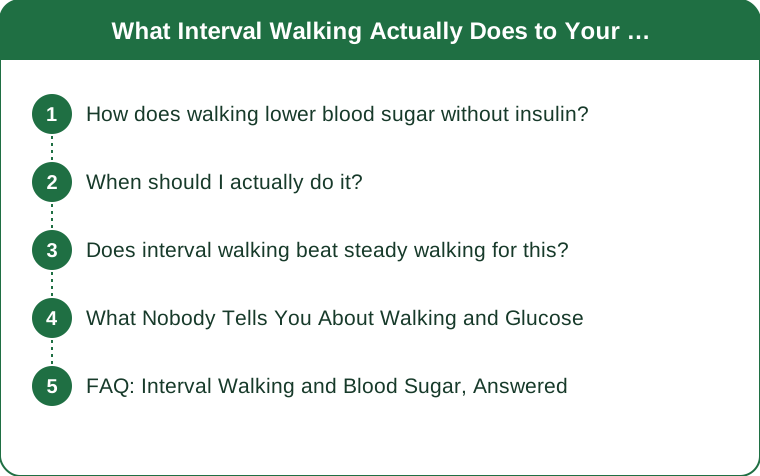
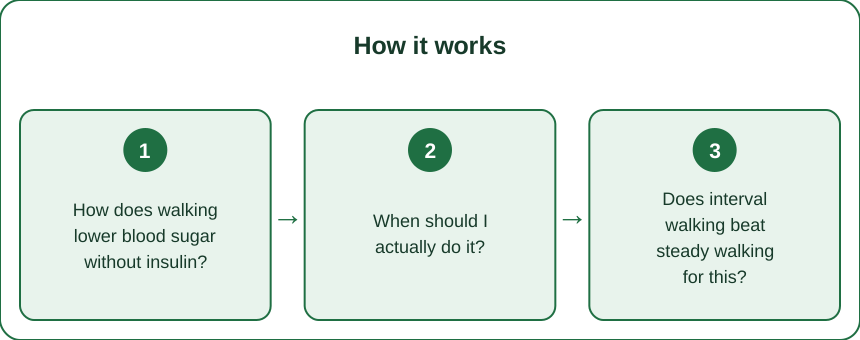
How does walking lower blood sugar without insulin?
Muscle contraction opens a separate door. Normally insulin has to signal your cells to take up glucose. Contracting muscle activates a second pathway that moves glucose transporters to the cell surface independently of insulin, which is why walking works even in people whose insulin signalling is impaired.
Working muscle is a large sink. Skeletal muscle is the biggest single site of glucose disposal in the body, and switching a large amount of it on for fifteen minutes changes where circulating sugar goes.
The effect starts within minutes. You do not need to complete a session to get it. Glucose uptake rises almost as soon as you start moving and continues while you keep moving.
Intervals recruit more than steady walking does. The faster segments bring in muscle fibres that easy walking never touches, and more recruited muscle means more glucose disposal for the same total time.
And the benefit outlasts the walk. Muscle that has just worked replenishes its glycogen stores afterwards, so improved insulin sensitivity persists for hours rather than ending at your front door.
When should I actually do it?
Aim for the window 30 to 90 minutes after eating — that is when blood sugar is climbing toward its peak for most people, and it is when a walk does the most work.
The largest meal of the day is the highest-value target. If you can only fit one walk in, put it after dinner rather than distributing effort evenly across the day.
Short is enough in this window. Research on post-meal walking repeatedly shows meaningful glucose reductions from ten to fifteen minutes, which is far more achievable than a full session and works better than the same time done at 7am.
Several short walks beat one long one for glucose specifically. For general fitness, one longer session is fine. For blood sugar, three ten-minute walks after three meals outperforms one thirty-minute walk in the morning.
Do not wait until you feel like it. The window closes. A walk two hours after eating is a good walk and it is no longer doing this particular job.
And on evenings when you cannot get out, walking around indoors still counts. The mechanism does not care about scenery.

Does interval walking beat steady walking for this?
Probably, and the margin is real but modest. The Japanese interval protocol — alternating three minutes brisk with three minutes easy — has been studied in older adults with results showing improvements in glucose control and other metabolic markers beyond what matched steady walking produced.
The mechanism is muscle recruitment. Faster segments bring in fast-twitch fibres that hold a lot of glycogen and that steady walking leaves largely idle.
Intensity is doing the work, not duration. This is why fifteen minutes of intervals can outperform thirty minutes of strolling for glucose, while burning fewer total calories.
But adherence beats optimisation. The protocol you actually do three times a day after meals beats the theoretically superior one you do twice a week. If intervals feel like too much after dinner, walk steadily and keep the timing.
And the two are not exclusive. Steady post-meal walks on weekdays and structured interval sessions two or three times a week is a sensible combination for most people.
What Nobody Tells You About Walking and Glucose
The response is highly individual. Two people eating the same meal and walking the same distance can show quite different glucose curves, driven by muscle mass, fitness, sleep, stress and even the previous night’s meal. General rules are a starting point, not a prescription.
Sitting straight after eating is the actual problem. Most of the benefit attributed to walking is really the avoidance of two hours of sitting during the glucose peak. Standing and light activity capture a good share of it, which is useful on days when a walk is impossible.
The scale will not show it and that is fine. Post-meal walking improves metabolic markers well before it changes body weight, and judging it by the scale is the most common reason people abandon something that is working.
Sleep changes tomorrow’s numbers more than today’s walk does. One short night meaningfully worsens insulin sensitivity the following day. A walk helps; it does not fully offset it.
Continuous glucose monitors have made this visible and also slightly obsessive. They are genuinely useful for learning your own patterns over a few weeks. They are less useful as a permanent scoreboard, and normal healthy people see spikes after meals that are not a problem.
And the autumn version matters. As evenings get darker and colder, the after-dinner walk is the first habit people drop, and it is the highest-value one they have. Planning for it — a jacket by the door, a headtorch, a fixed route — costs nothing in September and saves the habit in November.
One more: the walk does not need to be brisk to work. Comfortable walking already activates the insulin-independent pathway. Intensity adds to it; it is not the entry requirement.
FAQ: Interval Walking and Blood Sugar, Answered
Will this help if I already have type 2 diabetes?
Post-meal walking is widely recommended as part of management and has good evidence behind it. It is not a replacement for medical care, and any change in activity should be discussed with the professional managing your treatment, particularly if you take medication that lowers blood sugar.
Does it work after a low-carbohydrate meal?
The effect is smaller simply because there is less of a spike to blunt. The habit is still worth keeping for everything else it does.
Is walking before a meal useless then?
Not useless — it improves insulin sensitivity for the meal that follows. It is just less effective for that specific meal than walking afterwards.
TL;DR:
- Contracting muscle takes up glucose without needing insulin, so walking works through its own pathway.
- The 30 to 90 minutes after eating is the window that matters most; the largest meal is the best target.
- Ten to fifteen minutes is genuinely enough in that window — three short walks beat one long morning one.
- Intervals recruit more muscle and outperform steady walking modestly, but adherence beats optimisation.
- Judge it by how you feel and by markers, not by the scale.
Same walk, different hour, completely different result.
See It in Motion
Seen here: High Waist Yoga Leggings with Inner Pocket — shop it on bubblelime.com
Keep Reading
This article is for general informational purposes only and is not medical advice. Always consult a qualified health professional for guidance specific to you.