How Do You Restart Japanese Interval Walking After Two Weeks Off?
Quick Answer: After two weeks off, you have lost far less than it feels like - detraining in this timeframe is modest and mostly reversible within a week or two. Restart at roughly 80% of your previous fast-interval effort for the first two sessions, keep the standard 3 minutes fast / 3 minutes easy structure, and do four intervals instead of five. You should be back at full sessions by the end of week one and back at your previous pace within two weeks.
The mistake is not going too easy. It is going straight back to your old numbers on day one and being sore enough to skip day three.

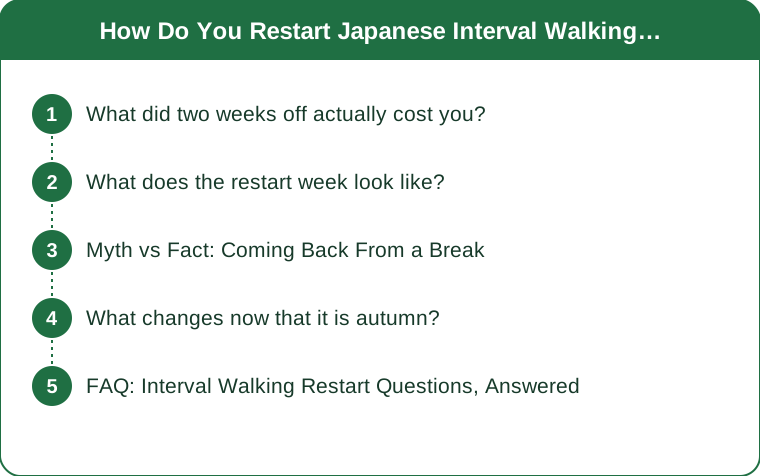
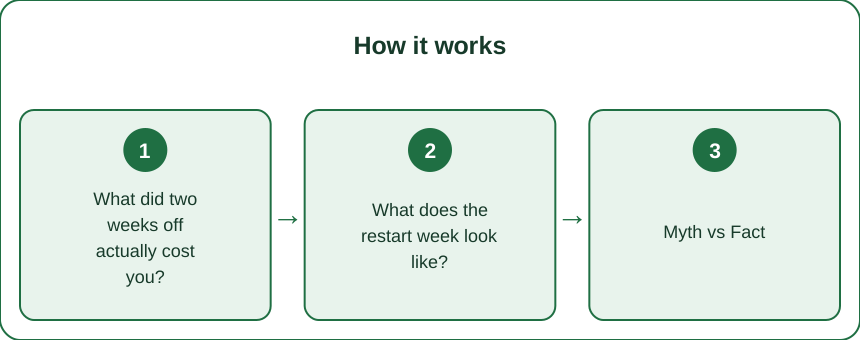
What did two weeks off actually cost you?
Less than the guilt suggests, and the specifics are reassuring.
Cardiovascular fitness declines slowly at first. Meaningful VO2max losses generally begin after about two to three weeks of complete inactivity, and after 14 days the loss is typically small - often in the range of a few percent.
Blood volume drops faster than anything else and is one of the first things to decline. This is why the first session back feels disproportionately hard even though your actual fitness is nearly intact. It also recovers within about a week of resuming.
Muscular endurance in the legs holds up well over two weeks, particularly if you were still walking normally rather than lying down.
Habit is the real casualty. The routine, the time slot, the automatic nature of it - that is what two weeks erodes most, and it is the thing worth rebuilding deliberately.
The honest summary: the first session back will feel harder than your fitness warrants. Expect that, plan for it, and do not let it convince you that you have lost months.
What does the restart week look like?
Three sessions, structured to rebuild the habit rather than to prove anything.
Keep the format intact. The Japanese interval walking protocol is 3 minutes at a fast pace (around a 6 to 7 out of 10 effort, where talking is possible but not comfortable) alternating with 3 minutes at an easy pace, repeated five times for 30 minutes. Do not redesign it. Reduce the dose.
Session 1: four intervals instead of five, and take the fast segments at about 80% of your usual effort. You should finish thinking you could have done more. That is correct.
Session 2 (two days later): four intervals, fast segments at about 90%. Notice whether your legs recovered well from session 1 - that is your real information.
Session 3: back to five intervals at 90%. By the end of week one, you are essentially back.
Week two: five intervals at full effort, three or four sessions. Most people find their previous pace returns during this week without forcing it.
What to measure: heart rate recovery is the most useful single marker if you track it - how quickly your heart rate drops in the minute after a fast interval. That number improves visibly across the restart and gives you feedback that pace alone does not.

Myth vs Fact: Coming Back From a Break
Myth: You have to start from the beginning. Fact: Muscle memory and retained cardiovascular adaptation mean returning is far faster than building it the first time. Two weeks off is not two weeks back to square one - it is usually about one week of readjustment.
Myth: You should train harder to make up for lost time. Fact: This is the most common way people turn a two-week break into a six-week one. Excessive first-week intensity produces soreness, joint irritation, and skipped sessions.
Myth: If you cannot do 30 minutes you may as well not go. Fact: A 12-minute session restores the habit, which is the hardest part to rebuild. The habit is the asset; the fitness follows it.
Myth: The fast intervals should feel the same as before. Fact: They will feel harder at the same pace for the first few sessions, largely due to reduced blood volume. Judge by effort, not by pace, for the first week.
Myth: Walking is too gentle to need a structured return. Fact: Interval walking at a genuine 6 to 7 out of 10 effort is real training, and returning to it deserves the same graded approach you would apply to running. Calves and shins in particular need a few sessions to readjust.
What changes now that it is autumn?
The restart happens to coincide with the season shifting, and three things are worth adjusting.
Warm-ups need to be longer. In August, five minutes of easy walking was plenty. In cooler morning air, extend the easy walking before the first fast interval to 8 to 10 minutes. Cold calves and cold shins are where early-autumn walking niggles come from.
Layer for the third interval, not the first. You will be genuinely cold at the start and warm by minute twelve. A light layer you can unzip or tie around your waist solves this; dressing for the first five minutes guarantees you overheat by the middle.
Reduced daylight changes the route, not the plan. Darker mornings and evenings mean picking well-lit, even surfaces - fast intervals on unlit uneven paths is how ankles go over. Reflective details on your outer layer stop being optional from about mid-September.
Footwear deserves a check on restart. If your shoes have done a summer of walking, look at the outsole wear and the midsole creasing. Restarting a programme on worn shoes is a common and completely avoidable source of shin and knee complaints.
And the schedule needs to survive the dark. The evening walk that was easy in July light needs a deliberate new time slot, or it quietly disappears in October. Decide now rather than in six weeks.
FAQ: Interval Walking Restart Questions, Answered
How long until I am back where I was?
After a two-week break, most people are back to previous pace and volume within one to two weeks of consistent sessions. Longer breaks scale roughly, but never as slowly as the initial build.
Should I do more sessions per week to catch up?
No. Four sessions a week is the practical ceiling for most people, and the standard protocol calls for around four. Extra volume in week one buys soreness rather than fitness.
What if I feel fine on session one - can I go full effort?
You can, but the useful information arrives 24 to 48 hours later. The conservative first session costs you almost nothing and protects the rest of the week, which is the actual goal.
Does it still work if I split the 30 minutes into two shorter walks?
The original research protocol used a single continuous session, so that is the tested version. Split sessions are still valuable exercise and are far better than skipping, but keep the full format as the target.
How do I know my fast interval is fast enough?
Aim for an effort where you can speak in short phrases but not hold a comfortable conversation - roughly 6 to 7 out of 10. If you can chat easily, it is not a fast interval.
This is general information, not medical advice. If you are returning after illness or injury, check with a healthcare professional first.
TL;DR:
- Two weeks off costs less than it feels like - the first session is hard mainly because of reduced blood volume, which returns within a week.
- Restart with four intervals at about 80% effort, keep the 3 minutes fast / 3 minutes easy structure intact, and be back to full sessions by the end of week one.
- The habit is what actually eroded, so a short session that happens beats a full session that gets postponed.
- Autumn adjustments: longer warm-up (8 to 10 minutes), a removable layer, lit and even routes, reflective details, and a shoe check.
The thing worth holding onto is that the protocol is unusually forgiving. It is 30 minutes, it needs no equipment, and it rebuilds quickly - which means the only genuinely costly decision is treating a two-week gap as a reason to stop rather than as a week of easier walking.
See It in Motion
Seen here: High Waist Yoga Leggings with Side Pockets — shop it on bubblelime.com
Keep Reading
This article is for general informational purposes only and is not medical advice. Always consult a qualified health professional for guidance specific to you.