The Interval Walk: The Japanese Walking Method That Actually Works
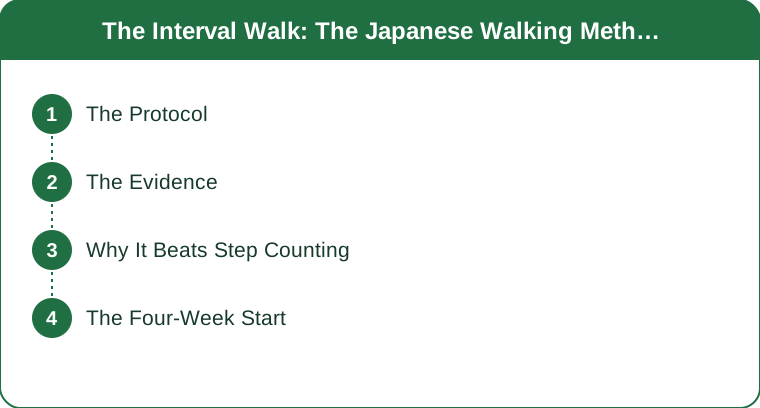
Quick Answer: Japanese walking — properly called Interval Walking Training (IWT) — is 3 minutes of fast walking alternated with 3 minutes of easy walking, repeated 5 times for 30 minutes total, about 4 days a week. It was developed at Shinshu University and tested on thousands of middle-aged and older adults, where it outperformed steady moderate walking on fitness, leg strength, and blood pressure.
Most viral fitness trends arrive with a testimonial and a ring light. This one arrived with roughly two decades of published research from a Japanese university, which is an unusual thing for TikTok to hand you.
The method is almost insultingly simple: walk fast for three minutes, walk easy for three minutes, do that five times. That’s it. The interesting part is why something that basic beats the thing you’re probably doing already.

What is Japanese interval walking?
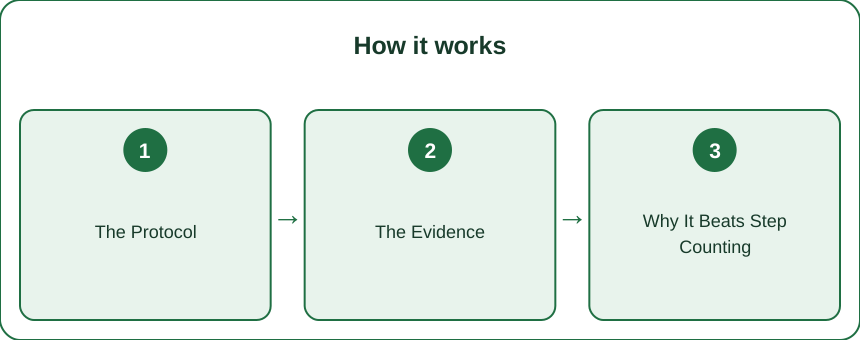
The full protocol:
- 3 minutes fast. A “somewhat hard” effort — roughly 70%+ of your peak capacity. The practical test: you can speak in short sentences but you couldn’t sing, and you’d rather not hold a conversation.
- 3 minutes easy. A genuine stroll. Not a moderate walk — easy. This is recovery, and treating it as “slightly less fast” is the most common way people ruin the session.
- Repeat 5 times. 30 minutes total.
- 4 or more days a week.
That’s the entire method. No equipment, no gym, no app strictly required — a phone timer runs it fine.
It was developed by researchers at Shinshu University in Matsumoto and studied over many years in large groups of middle-aged and older Japanese adults, which is why it comes with the kind of long-term data most walking advice badly lacks.
Does the Japanese walking method actually work?
The core comparison in the research put interval walkers against a control group doing steady moderate-intensity walking at a similar or higher total volume.
The interval group came out ahead on:
- Peak aerobic capacity (VO2 peak) — the single best-validated marker of cardiorespiratory fitness
- Leg strength — knee extension and flexion strength, which matters enormously for staying mobile with age
- Blood pressure — meaningful reductions in resting readings
- Metabolic markers associated with cardiovascular risk
The mechanism isn’t mysterious. Walking’s benefits are real but intensity-capped: at a comfortable pace, you eventually reach a point where more minutes stop producing more adaptation. The fast intervals reinstall the intensity your body needs to keep adapting — without requiring you to run, buy anything, or go anywhere.
It’s essentially the zone-2-plus-surges concept, delivered at the most accessible pace in existence.

Why it beats step counting
Step counts measure volume. Intervals deliver challenge. Adaptation needs challenge.
Ten thousand steps is a genuinely useful target for daily activity, and nothing here says drop it. But 10,000 comfortable steps at a comfortable pace, repeated for a year, mostly maintains where you already are. Your body has no reason to build more capacity for something it finds easy.
Three other advantages worth naming:
It’s low-impact intensity. For anyone whose knees, hips, or preferences rule out running, IWT is one of the few ways to reach vigorous effort without impact.
It’s time-bounded. 30 minutes, done, regardless of what your daily step total looks like. That’s a much easier thing to schedule than “walk more.”
It fixes the boredom problem. A 30-minute walk has no structure; an IWT session has a plot. Five rounds, each with a push and a recovery, and a clear finish line. People stick with it for this reason more than any other.
The two systems stack happily. Do IWT sessions inside a generally-walking life.
What nobody tells you about IWT
The easy interval is the part people get wrong. Nine out of ten beginners walk the “easy” three minutes at a brisk pace because slowing down feels lazy. Then the fast intervals degrade by round three and the whole session becomes a medium walk with extra steps. Go genuinely slow. The contrast is the entire mechanism.
Arm swing is the hidden speed control. Most people cap their fast pace by taking longer strides, which is inefficient and awkward. Drive the elbows back instead, at about 90 degrees, and cadence rises on its own.
You will feel absurd for the first two sessions. Alternating between speed-walking and strolling in public looks exactly as odd as it sounds. Round three of week one, you stop caring.
Hills replace the fast interval nicely. Once flat fast walking stops feeling hard, walk your three minutes uphill instead of faster. This is the graduation module and it’s free.
Success looks like the same pace feeling easier. By week four, the pace that had you breathing hard in week one should feel manageable. That’s the adaptation, right on the schedule the research describes.
The four-week starter plan
Week 1 — build the pattern. 3 rounds (18 minutes), 4 days. Fast segments at “brisk but comfortable.” The goal this week is the habit, not the intensity.
Week 2 — find the real fast pace. 4 rounds (24 minutes), 4 days. Fast segments now honestly fast: breathing hard, conversation choppy. If you could comfortably chat, go faster.
Weeks 3–4 — the full protocol. 5 rounds (30 minutes), 4+ days. Hold the pace, and note how each week feels compared to the last.
After week 4: add hills to the fast segments, add a fifth session, or add a light weighted vest (start at 4–5 kg). Don’t do all three at once.
Practical notes: any interval timer app works, or set two repeating alarms. Shoes matter more than you’d think at fast walking cadence. And if you’re walking outdoors, plan a loop rather than an out-and-back so a slow interval doesn’t leave you a long way from home.
When to check with a professional
The fast intervals are vigorous exercise. If you have known heart disease, uncontrolled high blood pressure, a recent injury, or you’ve been largely inactive for a long stretch, get clearance before starting — and start at 2 rounds rather than 3. Stop and seek medical attention for chest pain, unusual shortness of breath, or dizziness.
FAQ
How many days a week should I do interval walking?
Four or more, which is what the research protocol used. Three is still worthwhile; two is likely below the threshold for the fitness gains that made the method notable in the first place.
Can you do Japanese walking on a treadmill?
Yes, and it’s arguably easier to control. Set your fast pace and easy pace in advance and toggle between them every 3 minutes. Adding a 3–5% incline to the fast segments is a good substitute for outdoor hills.
Is Japanese walking better than running?
Not better — different, and more accessible. Running produces greater cardiovascular stimulus per minute for those who can do it comfortably. IWT delivers vigorous intensity without impact, which makes it the better option for a large group of people whose knees, weight, or joints make running a bad trade.
TL;DR:
- 3 minutes fast, 3 minutes easy, 5 rounds, 30 minutes, 4+ days a week.
- Developed and tested at Shinshu University over many years on middle-aged and older adults.
- Beat steady moderate walking on VO2 peak, leg strength, and blood pressure.
- Step counts measure volume; intervals supply the challenge that drives adaptation.
- Walk the easy interval genuinely slowly — the contrast is what makes it work.
- Four-week on-ramp: 3 rounds, then 4, then the full 5. Progress with hills before speed.
See It in Motion
Seen here: High Waist Yoga Leggings with Inner Pocket — shop it on bubblelime.com
Keep Reading
This article is for general informational purposes only and is not medical advice. Always consult a qualified health professional for guidance specific to you.