How to Do Interval Walking While Pushing a Stroller
Quick Answer: A stroller adds resistance and forces a forward-lean posture with fixed arms, which raises the effort of the fast intervals and removes arm swing as a speed tool. Adapt by shortening the fast intervals to two minutes, using terrain rather than pace to create intensity, and pushing with a tall posture and close hands. The training effect is comparable - the mechanics are not.
It is a genuinely effective workout, and it is not simply the normal one with a pram attached.

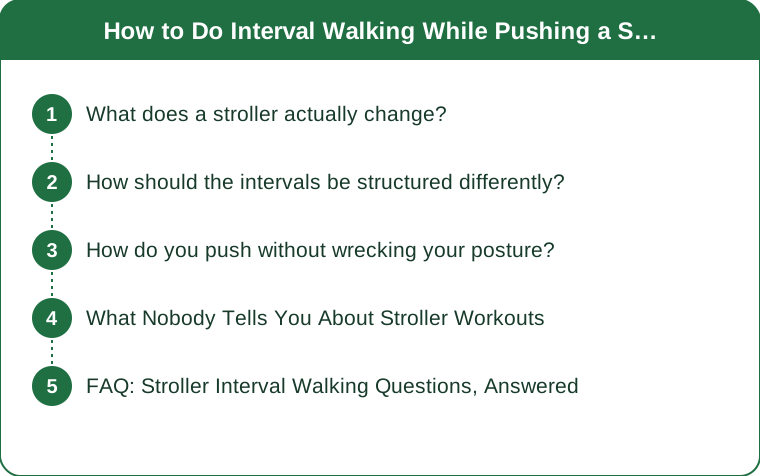
What does a stroller actually change?
Three things, and only one of them is the extra weight.
Added resistance, which varies enormously. A stroller with a child, a bag, and a coffee is 15 to 25kg being pushed, and rolling resistance changes dramatically with surface - smooth tarmac is easy, gravel and grass are several times harder. That variability is the main reason a fixed pace target does not work.
Fixed arms, which is the bigger deal. Fast walking normally relies on arm swing to drive cadence and generate momentum, and pushing removes it entirely. Your upper body becomes a static transmission rather than a contributor. That reduces top speed noticeably and shifts more of the work to the legs and hips.
A forward-lean posture, which is where the trouble starts. Pushing something encourages leaning into it, which produces the rounded-shoulder, hunched posture that is behind most stroller-walking complaints - lower back ache, neck tension, and shoulder tightness. It also mechanically reduces your stride length.
The combined result: the same perceived effort produces a slower pace, and the same pace produces higher effort. Both are true depending on the surface. This is why interval walking with a stroller feels harder than the numbers suggest, and why judging the session by pace leads to frustration.
The corollary is the useful part: use effort, not pace, to structure the session. Your watch is measuring the wrong thing here.
How should the intervals be structured differently?
The classic Japanese protocol - three minutes fast, three minutes easy, repeated five times - is a good starting point that needs two adjustments.
Shorten the fast intervals to two minutes. Without arm swing and against constant resistance, three minutes at a genuinely brisk effort is harder to sustain with good posture, and posture is the first thing to go. Two minutes fast, two minutes easy, repeated seven or eight times gives similar total work with better quality.
Use terrain as the intensity variable. This is the single most useful adaptation. Rather than trying to walk faster on the flat, put your fast intervals on inclines. A gentle hill with a loaded stroller produces a substantial effort at a modest pace, and it does so without forcing you into a posture-wrecking speed. On a route with a hill, simply making every uphill a fast interval and every downhill a recovery is an excellent, self-organising workout.
Recovery intervals should be genuinely easy. Because the resistance never goes away, the easy portions are less restful than they would be without a stroller. Slow right down - the recovery has to be real for the fast portion to be worth anything.
Total session: 25 to 35 minutes including a five-minute warm-up walk. Three to four times a week is a reasonable target and it fits the reality of the schedule better than longer sessions.
On the downhills: with a loaded stroller, downhill is where control matters. Braking a stroller on a descent with your arms extended is a shoulder and lower back strain waiting to happen - keep it close, shorten your steps, and do not treat descents as free speed.

How do you push without wrecking your posture?
Five points, and the first two matter most.
1. Keep your hands close and your elbows bent. Arms extended out in front puts the load far from your body and pulls your shoulders forward. Elbows at roughly 90 degrees, hands near your hips, stroller close. This one change resolves most stroller-related back and shoulder complaints.
2. Stand tall and push from the legs. The stroller should move because you are walking forward, not because your arms are pushing it ahead of you. Chest up, shoulders back and down, eyes on the path ahead rather than on the child.
3. Set the handle height properly. If the handle is adjustable, set it so your elbows are slightly bent with your shoulders relaxed. A handle that is too low forces a hunch and is the most common setup error - and worth checking, since many strollers are set to whoever last used them.
4. Alternate one-handed pushing occasionally. Thirty seconds pushing with the left, thirty with the right, during easy intervals. It restores some trunk rotation and lets one arm swing, which relieves the fixed-arm stiffness. Only on flat, safe, quiet paths.
5. Do not lean in on hills. The instinct on an incline is to lean the whole torso into the handle. What you want instead is a slight forward lean from the ankles with a straight line from ankle to head, and shorter, quicker steps. Same effect, no lumbar cost.
Add two minutes of chest and shoulder opening after the walk - a doorway stretch and a few thoracic rotations. The pushing posture shortens the front of the chest, and this offsets it in about the time it takes to unload the stroller.
What Nobody Tells You About Stroller Workouts
Route selection does more than programming. A route with a hill, smooth surfaces, and no road crossings turns into a good workout automatically. A route with six crossings and a gravel section will never produce clean intervals no matter how well you plan them. Spend the effort on finding the route once rather than on optimising the session repeatedly.
The child’s schedule beats the training schedule, always. Sessions that depend on a settled baby fail regularly. The workable approach is a route and a format you can abandon at any point without it feeling wasted - which is another argument for shorter intervals, since seven intervals with three completed is still a session.
Grass and gravel are the hidden intensity dial. Rolling resistance on grass with a loaded stroller is dramatically higher than on tarmac, and a soft-surface section will produce a hard interval at a walking pace. Useful when there is no hill available.
One-handed pushing is not a small thing. Extended periods of asymmetric pushing - phone in one hand, stroller in the other - is a genuinely common source of one-sided shoulder and back complaints. If it is happening a lot, the phone is the problem rather than the stroller.
Postpartum timing needs individual clearance. Return to exercise after birth depends on the delivery, on pelvic floor recovery, and on any complications - and general timelines from articles do not account for any of it. If you are early postpartum, get clearance and, ideally, an assessment from a pelvic health physiotherapist before adding brisk intervals. Leaking, heaviness, or pelvic pain during a session are signals to stop and get assessed, not to push through. This is general information, not medical advice.
Dress for standing still, not for walking. With a stroller you stop frequently - adjusting, soothing, retrieving a dropped toy - so you cool down more than you would on a continuous walk. As the mornings turn cooler, a layer more than you think you need is usually right.
FAQ: Stroller Interval Walking Questions, Answered
Is it a real workout or am I fooling myself?
Genuinely real. The added resistance means brisk stroller walking sits at a meaningfully higher effort than the same pace unloaded, and interval formats produce documented cardiovascular improvements. The pace looks unimpressive and the effort is not.
Should I use a running stroller even if I am walking?
If you have one, yes - three-wheeled strollers with larger wheels roll far better and are much easier to control at speed. For walking only, it is a convenience rather than a requirement.
How do I track effort if pace is unreliable?
Use the talk test. During fast intervals you should be able to speak in short phrases but not comfortably hold a conversation. During recovery you should be able to talk normally. It is more reliable here than any pace or heart rate target.
What about hills with a heavy toddler?
Excellent training and worth managing sensibly - shorter steps, stroller close, and a firm grip on descents. If the hill is steep enough that control is a concern going down, find a gentler one.
Can I do this every day?
Brisk walking is low-impact enough that daily is reasonable for most people. The thing to monitor is the shoulders and lower back, since the pushing posture accumulates. If those start complaining, alternate stroller days with unloaded walks.
TL;DR:
- A stroller adds resistance, removes arm swing, and encourages a forward lean - so pace becomes a poor measure of effort.
- Shorten fast intervals to two minutes and repeat seven or eight times. Make recovery genuinely easy.
- Use hills and soft surfaces as the intensity dial rather than trying to walk faster on the flat.
- Hands close, elbows bent, stand tall, handle height set correctly. That posture fixes most stroller-related aches.
- Pick the route once - smooth surface, a hill, no crossings - and the session organises itself.
Gauge it by whether you can talk in short phrases, not by what the watch says about your pace.
See It in Motion
Seen here: Maternity Capris with Side Pockets — shop it on bubblelime.com
Keep Reading
This article is for general informational purposes only and is not medical advice. Always consult a qualified health professional for guidance specific to you.