Interval Walking in High Humidity: What Actually Changes and How to Adjust
Quick Answer: High humidity blunts your body’s ability to cool itself through sweat evaporation, making the same pace feel significantly harder and raising real heat-strain risk. Shortening high-intensity intervals slightly and extending recovery walks, rather than abandoning the workout, keeps it effective and safer.
Your usual interval walking pace on a humid day suddenly feels like a completely different, much harder workout — and it’s not you losing fitness overnight. Humidity changes the physics of how your body handles the effort.

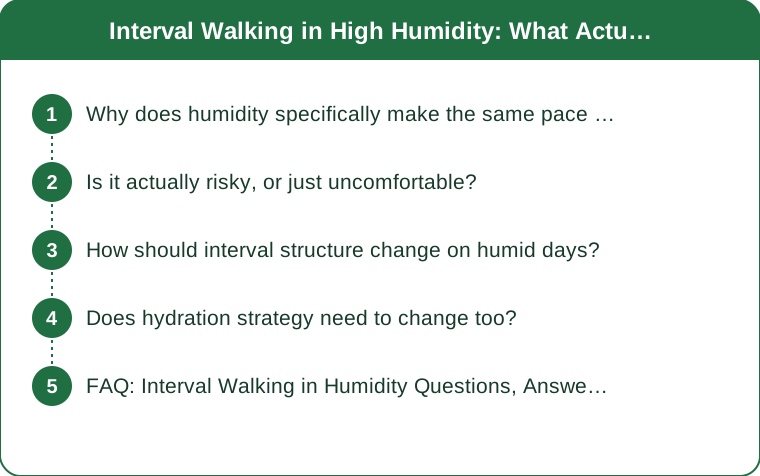
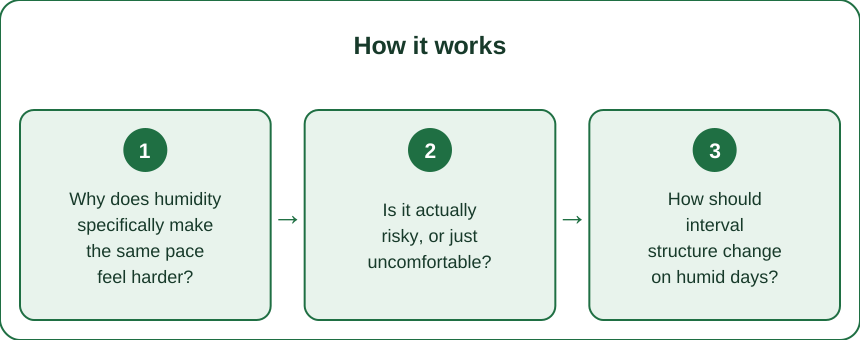
Why does humidity specifically make the same pace feel harder?
Your body cools primarily through sweat evaporation, which requires dry air to work efficiently. In high humidity, sweat can’t evaporate as effectively, so your core temperature climbs faster at the same effort level compared to a dry-heat or cooler day — this is a real physiological difference, not just a mental perception of harder effort.
Is it actually risky, or just uncomfortable?
Beyond a certain humidity and temperature combination, it becomes a genuine heat strain risk, not just discomfort — symptoms like dizziness, unusually rapid heart rate for the effort level, or stopping sweating altogether (a serious warning sign) mean the workout needs to stop immediately, not just slow down.

How should interval structure change on humid days?
Shortening high-intensity interval segments by 20-30% while keeping recovery walk segments the same length or slightly longer maintains the training stimulus without pushing core temperature into risky territory. This isn’t abandoning the workout format, just adjusting the work-to-rest ratio for the conditions.
Does hydration strategy need to change too?
Yes — humid-day sweat loss is often higher than people estimate precisely because the sweat doesn’t evaporate visibly the same way, leading people to underestimate how much they’ve actually lost. Pre-hydrating and carrying water for sessions over 20-30 minutes matters more on humid days than on dry, cooler ones.
FAQ: Interval Walking in Humidity Questions, Answered
What humidity or heat index level should make me move the workout indoors?
Many health guidelines flag a heat index above roughly 90-95°F combined with high humidity as a point to move training indoors or to early morning/evening, though individual heat tolerance varies.
Does time of day matter as much as humidity level itself?
Yes — early morning or evening sessions avoid peak humidity and heat combined with peak sun exposure, which is often the more practical adjustment than trying to train through midday humidity.
Will my pace naturally improve as I acclimate to humid conditions over the summer?
Somewhat — heat and humidity acclimation is a real physiological adaptation that develops over 1-2 weeks of consistent exposure, though it has limits and doesn’t fully eliminate the harder-effort effect of genuinely high humidity.
TL;DR:
- High humidity blunts sweat evaporation, the body’s main cooling method, making the same pace feel harder
- Beyond a certain point it’s a genuine heat strain risk, not just discomfort — know the warning signs
- Shortening high-intensity intervals while keeping recovery segments the same maintains the workout safely
- Humid-day sweat loss is often underestimated since it doesn’t evaporate visibly — hydrate proactively
See It in Motion
Seen here: High Waist Yoga Leggings with Side Pockets — shop it on bubblelime.com
Keep Reading
This article is for general informational purposes only and is not medical advice. Always consult a qualified health professional for guidance specific to you.