How to Do Interval Walking in a City Full of Traffic Lights
Quick Answer: The Japanese interval walking protocol alternates three minutes fast with three minutes slow, and a red light every 90 seconds destroys the structure. Three workable adaptations: use the lights as your slow intervals rather than fighting them, switch to a distance-based structure using blocks instead of minutes, or move to a longer 5-and-5 pattern that absorbs interruptions. The physiological target is repeated periods of genuinely brisk effort - the clock is a convenient way to organise that, not the mechanism itself.
A slightly ragged interval session you actually do beats a perfect one that requires a park you do not live near.

What actually matters in the protocol?
Knowing what is essential tells you what you are allowed to change.
The core of interval walking is the contrast - periods of genuinely brisk walking, around 70 percent of peak effort, where holding a conversation becomes difficult, alternating with easy recovery walking at around 40 percent. The research protocol uses three minutes of each, repeated five times, for about 30 minutes total, several days a week.
What is essential:
- The fast segments need to be genuinely hard. This is the part people water down, and it is the part that produces the results
- There need to be enough of them. Five fast segments is the standard, and fewer than three or four in a session is a different workout
- Recovery needs to be real recovery, not merely slightly slower
What is flexible:
- The exact three minutes. There is nothing magic about the number - it is a practical duration that most people can sustain at that effort
- Whether the intervals are equal. A slightly longer recovery is fine
- Total session length, within reason
So the traffic light problem is not a physiological problem. It is a timing inconvenience, and the effort contrast can be preserved several ways once you stop treating the three-minute figure as the intervention itself.
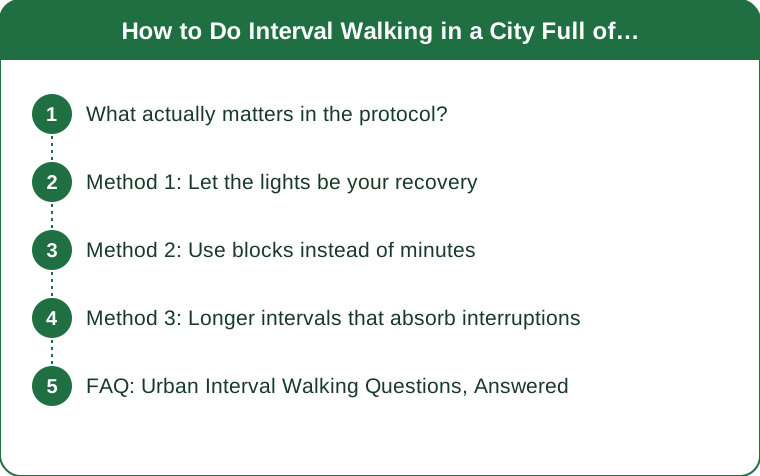
Method 1: Let the lights be your recovery
The simplest adaptation, and the one that suits dense city centres with frequent crossings.
The rule: walk fast between crossings, recover at them. Every red light becomes a recovery period. Every green stretch is a fast segment.
Why it works better than it sounds. Recovery intervals do not need to be walking - standing still at a crossing is a deeper recovery than slow walking, which means your fast segments can be genuinely harder. The contrast, which is what matters, actually increases.
How to make it a real session:
- Count the fast segments, not the minutes. Aim for at least five stretches of genuinely brisk walking per session
- If a stretch is under 60 seconds, do not count it - it is too short to be a working interval. Combine it with the next one by continuing hard through the crossing if it is clear
- If you get a long green run of four or five minutes, take it - a longer fast segment is not a problem
The obvious limitation: if your route has a crossing every 40 metres, this does not work and you need method two or a different route. Check whether one street parallel to your usual one has fewer crossings - in most cities it does, and that single change fixes the problem entirely.

Method 2: Use blocks instead of minutes
For grid-pattern cities and anywhere with regular block spacing, this is the cleanest solution.
The structure: fast for two blocks, easy for one block. Or fast for one long block, easy for one, depending on block length. You are substituting distance for time, which is completely legitimate - the effort is what matters and the distance is just a way of measuring it.
Why it is better than clock-watching in a city: you stop looking at your watch. Landmarks are easier to pace against than a timer, and you naturally cross at whatever point you arrive rather than being interrupted mid-interval.
Calibrating it:
- Walk your route once at an easy pace and time a block. If a block takes 90 seconds easy, then two blocks fast is roughly the right duration
- Adjust the ratio, not the effort. If two blocks fast is too much, do one fast and one easy. Never solve it by reducing how hard the fast segment is
- Aim for 25 to 35 minutes total, which in most cities is somewhere between 12 and 20 blocks
A useful side effect: the route becomes a fixed thing you can compare over weeks. Doing the same city loop faster is a much better progress measure than any of the numbers a watch gives you.
Method 3: Longer intervals that absorb interruptions
For routes with occasional rather than constant interruptions, extend the intervals so a single stop does not matter.
The structure: five minutes fast, five minutes easy, three rounds. A 45 second wait inside a five minute fast segment costs you 15 percent of that interval. The same wait inside a three minute segment costs 25 percent and breaks the rhythm.
Longer intervals are harder in a different way. Five minutes at a genuinely brisk pace is a bigger ask than three, so many people find they naturally drop the intensity slightly - which is acceptable as long as it stays clearly in the hard zone. If five minutes forces you down to a moderate stroll, use four.
When to pick this one: suburban routes, riversides with occasional road crossings, and park loops with one or two interruptions per lap. It is the wrong choice for a dense centre, where the interruptions are too frequent for any interval length to absorb them.
Combine it with route design. Ten minutes of walking to reach a stretch with no crossings, three rounds of 5-and-5 there, and ten minutes home is a better session than 30 minutes of fighting traffic, and the transit portions are perfectly good easy walking.
FAQ: Urban Interval Walking Questions, Answered
Does stopping completely ruin the interval effect?
No. Recovery is recovery, and standing still is simply a more complete version of it. What matters is that the fast segments are hard and that there are enough of them. If anything, complete recovery lets you go harder on the next fast segment.
Should I use a heart rate monitor to keep it honest?
It helps, particularly early on when your sense of the effort is still calibrating. But in a city with frequent stops the heart rate never settles, so the numbers are messier than they would be on a track. The talk test is more practical here - if you can talk in full sentences during a fast segment, go faster.
Is hill walking a good substitute for the fast intervals?
Yes, and in a hilly city it is a natural fit - walk hard up, recover down. The effort contrast is built into the terrain and no timing is required at all. This is often the easiest version for anyone who lives somewhere with gradient.
How many days a week?
The original research protocol used four or more days a week, which is achievable precisely because it is walking. Three is a reasonable starting point and produces real change; adding days matters more than adding length to any single session.
TL;DR:
- The intervention is the effort contrast, not the three-minute clock - so the timing is negotiable
- Let crossings be your recovery and count fast segments instead of minutes; aim for at least five
- In grid cities, use blocks instead of minutes - easier to pace and it makes the route comparable week to week
- On routes with occasional interruptions, 5-and-5 absorbs a stop better than 3-and-3 does
- A hill route removes the timing problem entirely, since the terrain sets the intervals for you
Try the street one block over from your usual route this week and count the crossings. Most people find a version with half the interruptions within two streets of where they already walk.
See It in Motion
Seen here: High Waist Yoga Leggings with Inner Pocket — shop it on bubblelime.com
Keep Reading
This article is for general informational purposes only and is not medical advice. Always consult a qualified health professional for guidance specific to you.