Interval Walking After Dark: Safety and Structure
Quick Answer: Three things change when interval walking moves into the dark. Your visual input drops, which slows your natural pace and makes the fast intervals harder to hit without looking at a watch. Uneven ground you cannot see raises the risk during the fast phase specifically, since that is when your stride lengthens. And the route options that were fine at 6pm in August may not be at 6pm in November. The adjustments are to use time-based rather than pace-based targets, switch to a lit loop rather than an out-and-back, and shift the intensity to a familiar known surface.
The Japanese interval walking protocol is three minutes fast, three minutes slow, repeated five times. Simple in daylight.
In the dark, the fast three minutes is where everything gets more complicated, and it is worth rethinking rather than just doing the same thing with a headlamp.
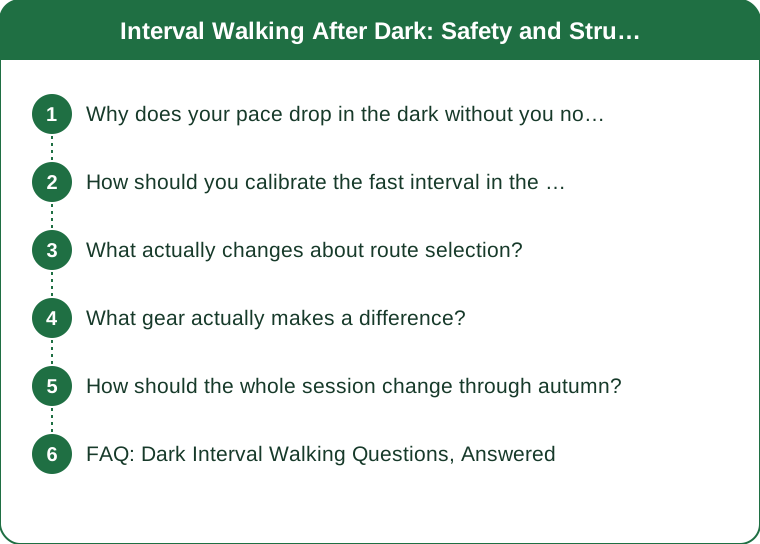
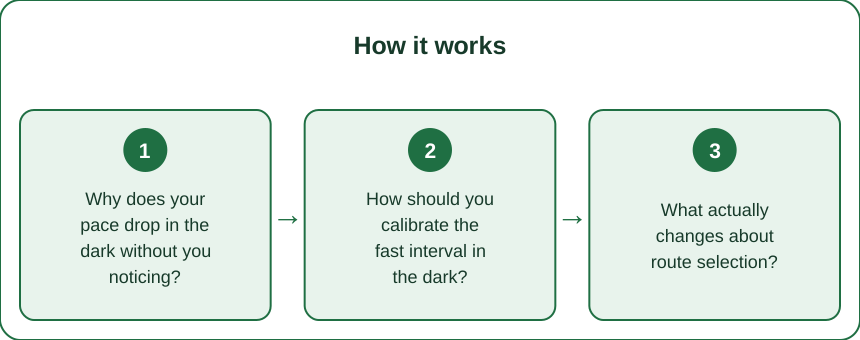
Why does your pace drop in the dark without you noticing?
Because a substantial part of walking speed is set by visual information you are not conscious of using.
Your visual system continuously scans the ground ahead and feeds that into stride planning. With less light, less information arrives, and your motor system responds by shortening stride and increasing ground contact time. This is automatic and protective.
The measured effect is not trivial. Studies of gait in reduced lighting consistently find slower walking speed, shorter steps, and more cautious foot placement, particularly on unfamiliar surfaces.
Why this matters for interval walking specifically: the protocol depends on the fast intervals reaching a genuinely brisk effort, generally around 70 to 85 percent of peak aerobic capacity. If your pace drops 8 percent because of the lighting, the fast interval may not be reaching the intensity that the protocol’s benefits depend on.
And you will not notice, because perceived effort adjusts too. The walk feels the same. The stimulus is smaller.
The fix is to stop using pace as the target. Use effort, and calibrate it deliberately.
How should you calibrate the fast interval in the dark?
Use a breathing test rather than a pace or a distance.
The talk test, applied specifically: during the fast three minutes, you should be able to speak in short phrases but not full sentences. If you can hold a normal conversation, it is too easy. If you cannot get out four or five words, it is too hard for this protocol.
A second marker: at the end of each fast interval you should genuinely want the slow interval to start. If the transition arrives and you are indifferent, the intensity was low.
If you use a heart rate monitor, this is the season where it earns its place. Set a target zone from a daylight session where you knew the effort was right, then work to that zone in the dark. Heart rate is unaffected by lighting in a way that pace and perception are not.
A practical calibration session: do one walk in daylight, note your heart rate and your subjective breathing state during the fast intervals, and use both as your reference for the next few months. Twenty minutes now saves a season of accidentally easy intervals.
What actually changes about route selection?
The fast interval is where the risk concentrates, and route design should reflect that rather than treating the whole walk equally.
During the fast three minutes, your stride lengthens, your heel strike is further ahead of your body, and you are looking further down the path rather than at your feet. That combination is exactly what makes an unseen edge, root, or pothole a problem.
Route principles for dark walking:
Use a lit loop rather than an out-and-back. A short well-lit loop repeated several times means you learn the surface within the first lap and every subsequent fast interval happens on ground you know.
Put the fast intervals on the best surface. If your loop has a smooth lit section and a rougher one, structure the intervals so the fast phase lands on the smooth section. This is easy to do with a loop of the right length and impossible on a linear route.
Avoid leaf-covered paths for fast intervals specifically. This is the autumn hazard that catches people. Wet leaves hide surface irregularities and are genuinely slippery, and the fast interval is when you have the least margin.
Favor routes with people on them. Personal safety is a legitimate route criterion and it is fine to prioritize it over route quality.
Consider a treadmill for the fast intervals if your outdoor options are genuinely poor. The protocol works on a treadmill, and there is no shame in moving indoors for the darkest months.
What gear actually makes a difference?
A short list, since most of it is unnecessary.
Reflective material on moving parts. Reflective panels on your ankles and wrists are far more visible to drivers than reflective material on your torso, because motion is what the eye detects. This is a genuinely large difference for a small cost.
A light you can see the ground with, not just be seen by. A small headlamp or a chest light angled down. Being visible and being able to see are different problems and most reflective gear only solves the first.
Footwear with intact tread. Worn-out tread matters much more on wet leaves and damp pavement than on dry summer ground. Look at the outsole; if the pattern is smooth in the forefoot, replace them before winter rather than after a slip.
A layer you can walk in for the slow interval. The three-minute slow phase is where you cool down fast, particularly if there is any wind. A light windproof layer solves this better than a warmer one, since it is convection rather than air temperature doing most of the cooling.
What you do not need: specialized night walking shoes, expensive high-lumen lights, or any of the reflective vests marketed at runners, which are usually less effective than ankle bands for the money.
How should the whole session change through autumn?
Three adjustments that follow the season rather than the calendar.
Extend the warm-up. In warm weather, the first slow three minutes is enough of a warm-up. In cold air, it is not. Add 5 minutes of easy walking before the first interval, more if it is genuinely cold. Cold muscle is less compliant and the first fast interval is where a calf strain is most likely.
Consider shortening the session and keeping the frequency. A 30-minute session done four times a week does more than a 50-minute one done twice, particularly through a season where the barrier to going out is rising. The protocol’s benefits track weekly volume and consistency, not session length.
Watch the fluid intake. People drink noticeably less in cool weather, and thirst is a less reliable signal in the cold. The dehydration risk of a brisk 40-minute walk in November is lower than in July and it is not zero, and the drop in intake is often larger than the drop in loss.
Move the session earlier if you can. Not for safety reasons alone, but because compliance drops sharply once a session is scheduled after dark. If the walk can move to a lunch break or an early evening slot before full dark, it is far more likely to keep happening through the winter. That reliability is worth more than any adjustment to the intervals themselves.
This is general information, not medical advice.
FAQ: Dark Interval Walking Questions, Answered
Is it safe to do interval walking in the dark?
With a lit, familiar loop and attention to surface conditions, yes. The fast intervals carry more risk than the slow ones because your stride lengthens and your gaze moves further ahead, so put those on the best-lit and smoothest section.
How do I know if my fast interval is hard enough when I cannot judge pace?
Use breathing. You should manage short phrases but not full sentences. A heart rate monitor calibrated during a daylight session is the most reliable option.
Should I switch to a treadmill for winter?
The protocol works on a treadmill and there is nothing lost by moving indoors. If your outdoor route options are poor after dark, the treadmill is a better answer than skipping sessions.
TL;DR:
- Reduced light automatically shortens your stride and slows your pace, and perceived effort adjusts, so the fast interval quietly gets easier.
- Use breathing or heart rate as the target instead of pace. Calibrate once in daylight and carry the reference into the dark.
- Use a lit loop rather than an out-and-back, and place the fast intervals on the smoothest, best-lit section.
- Reflective material on ankles and wrists beats a reflective vest, because motion is what drivers detect.
- Wet leaves during a fast interval is the specific autumn hazard. Route around it.
The protocol still works after dark. It just stops self-regulating, so you have to supply the calibration the daylight was giving you for free.
See It in Motion
Seen here: High Waist Yoga Leggings with Side Pockets — shop it on bubblelime.com
Keep Reading
This article is for general informational purposes only and is not medical advice. Always consult a qualified health professional for guidance specific to you.