Can You Do Japanese Interval Walking on a Treadmill? The Complete Adaptation
Quick Answer: Yes - interval walking training (IWT, the Japanese 3-minutes-fast, 3-minutes-easy protocol) adapts fully to the treadmill, and for many people it works better there: exact speed control, no intersections interrupting an interval, weather immunity, and honest effort tracking across months. The three problems to solve are the machine’s slow speed transitions (start each change 15-20 seconds early or straddle-and-hop safely), the handrail trap (holding on deletes a meaningful share of the workout), and the missing variety of real ground (solved with small incline changes). Typical settings: easy pace around 2.5-3.2 mph, fast pace 3.8-4.5 mph or 1-2 percent incline added - calibrated by the talk test, not the display.
The famous Matsumoto walking studies that launched the 3-3 method ran on ordinary streets with a beeping device and a coach. Your version can run in a climate-controlled room on a belt that obeys to the tenth of a mile per hour - which, from late-summer heat waves straight through winter, might be exactly why yours actually happens five times a week.

What transfers to the belt - and what genuinely changes
The physiology transfers completely. IWT’s engine is alternation: three minutes at a genuinely brisk effort (around 70 percent of capacity - breathing hard, short sentences only), three minutes easy, repeated five times, most days of the week. The landmark trials behind the method showed superior gains in fitness, blood pressure, and leg strength versus steady moderate walking - and none of that mechanism cares whether the ground moves under you or you move over the ground. Effort alternation is the medicine; the treadmill is just a different spoon.
What the treadmill adds: precision and honesty. Outdoors, fast intervals quietly decay as fatigue builds - the pace you believe is brisk at interval five is often slower than interval one. The belt does not participate in this fiction: 4.2 mph is 4.2 mph at minute one and minute twenty-five. For a protocol whose entire value lives in the fast phases being genuinely fast, that honesty is a feature worth the monotony. Add perfect interval timing (no traffic lights mid-fast-phase), weather immunity, and a stable surface for anyone with balance concerns, and the indoor case is strong.
What it subtracts: wind resistance and terrain mean belt walking at a given speed costs slightly less than street walking - the standard fix is a 1 percent incline as the outdoor-equivalence baseline. Gone too are the micro-adjustments of real ground (curbs, cambers, surface changes) that quietly train ankles and balance - worth re-adding via incline variety and, ideally, keeping one outdoor session a week when the season allows.
And the psychology differs in both directions: some walkers find belt intervals meditative - the machine holds the discipline, you just keep up; others find thirty minutes of wall dull beyond endurance. The adaptations below solve the mechanics; the entertainment strategy (episode-length shows measured in intervals, playlists with three-minute songs) solves the rest.
Settings, speed changes, and the handrail rule
Finding your two speeds. Start conservatively: easy phase around 2.5-3.2 mph - full-sentence conversational; fast phase around 3.8-4.5 mph - short-phrases-only, definitely-working. The talk test outranks the display: your fast speed is whatever makes three minutes feel honestly demanding by minute two, and it will creep upward over the weeks as fitness builds - that creep is the progress metric. Taller strides run faster at both ends; the numbers are starting points, not prescriptions.
Solving the transition lag. Belts take 10-20 seconds to swing between speeds - dead time that blunts the interval contrast if ignored. Three workable solutions, in order of simplicity: start each speed change 15 seconds before the phase ends (the machine arrives on schedule); use the treadmill’s speed presets or quick keys if it has them (one press beats holding an arrow); or - for experienced treadmill users only, on machines with wide side rails - the straddle method: feet to the rails, adjust speed, rejoin the belt with hands briefly on the rails for the step-on. The straddle saves the most time and carries the most risk; nobody should attempt it while distracted, tired, or new to the machine.
The handrail rule: hands off during work phases. Holding the rails unloads body weight, shrinks the leg-strength stimulus that made IWT famous, and kills the arm swing that pushes the fast phase’s intensity - measured energy cost drops meaningfully with rail support. Rails are for mounting, dismounting, transitions, and genuine balance needs (for which they exist and should absolutely be used). If you cannot complete a fast phase without holding on, the correct fix is a slower fast phase, not a supported faster one.
Incline as the second dial. Adding 1-2 percent to the fast phase - or running fast phases at 3.5 mph and 3-4 percent instead of 4.4 mph flat - reaches the same effort with less joint impact and less runaway-belt anxiety. Incline-based fast phases are the standard adaptation for anyone whose comfortable fast walk tops out below the effort target.
What Nobody Tells You About Belt-Based Intervals
The display is a pacing tool, not a report card. Treadmill calorie counts are estimates with generous error bars; the meaningful metrics are your fast-phase speed trend across weeks, completed sessions per week, and how sentence-length at 4.2 mph changes over a month. Track those three and ignore the cartoon flames.
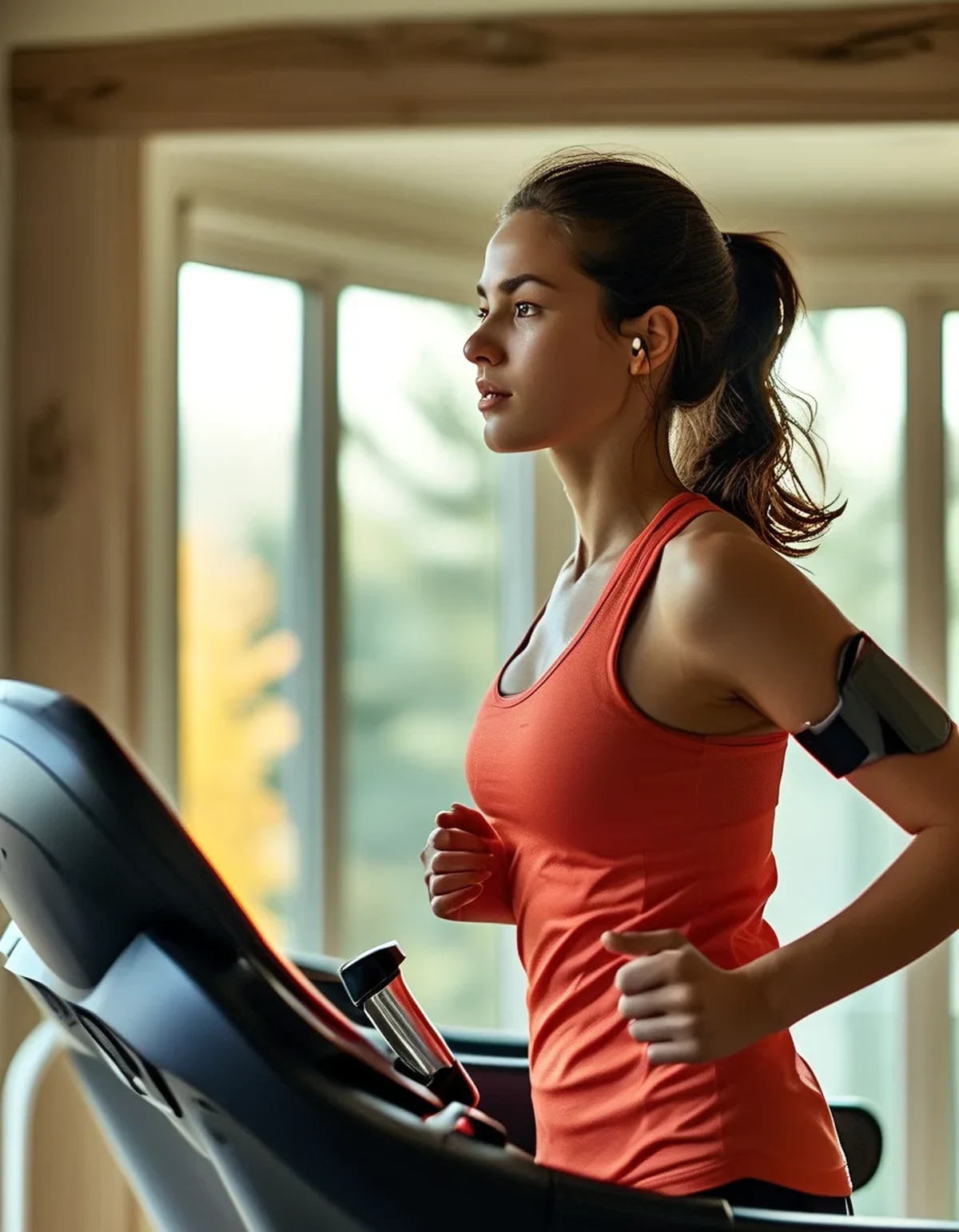
Belt walking changes your stride subtly. People unconsciously shorten steps and drift toward the console, especially at faster speeds - which cramps the arm swing and posture that give the fast phase its full value. The fixes: eyes ahead (not at your feet or the display), position mid-belt with room in front, and deliberately full arm swing - elbows around 90 degrees, hands sweeping hip to chest. If your shoulders ache pleasantly the first week, the arm swing is finally real.
Music with the right tempo is a legitimate pacing engine. Three-minute songs are practically purpose-built for the protocol - fast song, easy song, repeat five times, done. Playlist-as-timer removes all clock-watching, which is the single biggest boredom fix, and cadence-matched music measurably steadies pace.
Dress for the machine’s weather, not the world’s. Indoor rooms without airflow run warm - a fan pointed at the treadmill changes everything - and belt walking in heavy outdoor layers is the classic overheating error. Treat it like a gym session: breathable top, and bottoms that move - the same leggings that handle a workout class beat street clothes on a belt every time, and the phone lives in a pocket or holder, never in your hand mid-fast-phase.
The safety clip is not decorative. Attach the magnetic stop cord to your clothing for every session that includes speed changes - the one time a transition goes wrong is precisely when you want the belt to die instantly. And step off only at easy-phase speeds; dismounting a fast belt is how treadmill stories end up on video.
Finally, the schedule superpower: the original research aimed for 60-plus fast minutes per week - five sessions of five fast intervals. Treadmill access converts that from a weather-dependent aspiration into a checkbox routine, which is why indoor IWT adherence through August heat and January dark routinely beats the sidewalk version’s.
Three treadmill IWT workouts - beginner to advanced
The standard 3-3 (thirty minutes). Three-minute warm-up at easy pace. Then five rounds: 3 minutes fast (talk-test calibrated, rails untouched), 3 minutes easy. Two-minute cool-down. Speed changes initiated 15 seconds early. This is the researched protocol, and most people should simply run it four or five days a week and let the fast-phase speed creep tell the progress story.
The incline variation (joint-friendly). Same structure, but fast phases at a moderate speed (3.3-3.7 mph) with 3-5 percent incline, easy phases flat. Same breathlessness, less impact, and a quietly serious glute-and-calf stimulus the flat version lacks. Also the right version for anyone whose balance gets sketchy at faster belt speeds - effort without velocity.
The pyramid (for the bored and established). Warm-up, then fast phases of 2-3-4-3-2 minutes with matching easy phases between, playing the incline up one percent on the middle interval. Same total fast time as the standard, completely different psychological texture - the four-minute summit gives the session a story, which is worth more for adherence than any physiological tweak.
Progression rules across all three: hold each fast speed until it stops producing short-sentence breathing by minute two, then add 0.1-0.2 mph; never progress speed and incline the same week; and keep easy phases genuinely easy - the recovery phase doing its job is what lets the fast phases stay honest. If week four’s fast pace equals week one’s and feels easier, that is the protocol working exactly as designed.
And keep one foot outdoors when the season is kind. A weekend sidewalk or trail session preserves the terrain-and-balance training the belt cannot supply, keeps the habit portable, and - in late August - reminds you why the treadmill earned its place from June through the heat. The strongest IWT practice is bilingual: belt for consistency, ground for variety.
This is general information, not medical advice - anyone with cardiovascular conditions, balance disorders, or new symptoms during exercise should involve a clinician in protocol and intensity decisions.
FAQ: Treadmill Interval Walking, Answered
What treadmill speeds match the Japanese walking method?
Typical starting points: easy phases at 2.5-3.2 mph, fast phases at 3.8-4.5 mph or a moderate speed plus 2-4 percent incline - but calibrate by the talk test, since the target is effort (hard-but-sustainable, short sentences only) rather than any universal number. Your correct fast speed rises over the weeks; that rise is the progress metric.
How do I handle the treadmill’s slow speed changes between intervals?
Start each change 15-20 seconds before the phase boundary so the belt arrives on time, or use speed presets if your machine has them. The rail-straddle-and-adjust method is faster but belongs only to experienced users on machines with wide rails - and always with the safety clip attached.
Is holding the handrails during fast intervals okay?
It quietly deletes a chunk of the workout: rail support unloads the legs, reduces energy cost, and eliminates the arm swing that drives fast-phase intensity. Use rails for mounting, transitions, and genuine balance needs; if a fast phase requires holding on, slow that phase down instead. Balance-limited walkers should prefer the incline variation at moderate speeds.
Should I set an incline to mimic outdoor walking?
A 1 percent baseline roughly compensates for the missing wind resistance, and 2-5 percent on fast phases is a legitimate way to reach target effort with less speed and impact. Vary it - flat easy phases, inclined fast phases - to restore some of the terrain variety sidewalks provided for free.
Is treadmill IWT as effective as doing it outside?
The core adaptations - fitness, blood pressure, leg strength - follow the effort alternation, which the treadmill reproduces exactly and times more precisely. You lose terrain variety and balance micro-training, gain pace honesty and all-weather consistency, and adherence usually decides the contest: the version you complete five days a week is the effective one. Mixing both is the best answer of all.
TL;DR:
- IWT adapts fully to the treadmill: the 3-fast-3-easy alternation is the medicine, and the belt delivers it with perfect timing and honest pacing.
- Solve the three machine problems: start speed changes 15-20 seconds early, keep hands off rails during work phases, and use incline for variety and joint-friendly intensity.
- Calibrate by talk test - short sentences during fast phases - and let the slow upward creep of your fast speed be the progress report.
- Safety clip on for every session with transitions; dismount only at easy speeds; fan, breathable clothes, phone in a pocket.
- Aim for the researched dose - five sessions, 60-plus fast minutes weekly - and keep one outdoor walk for terrain when the season allows.
The sidewalk invented the protocol; the treadmill industrialized it. Belt for the streak, ground for the scenery - and the 3-3 rhythm, either way, does the rest.
See It in Motion
Seen here: Yoga Jogger Sweatpants with Pockets — shop it on bubblelime.com
Keep Reading
This article is for general informational purposes only and is not medical advice. Always consult a qualified health professional for guidance specific to you.